
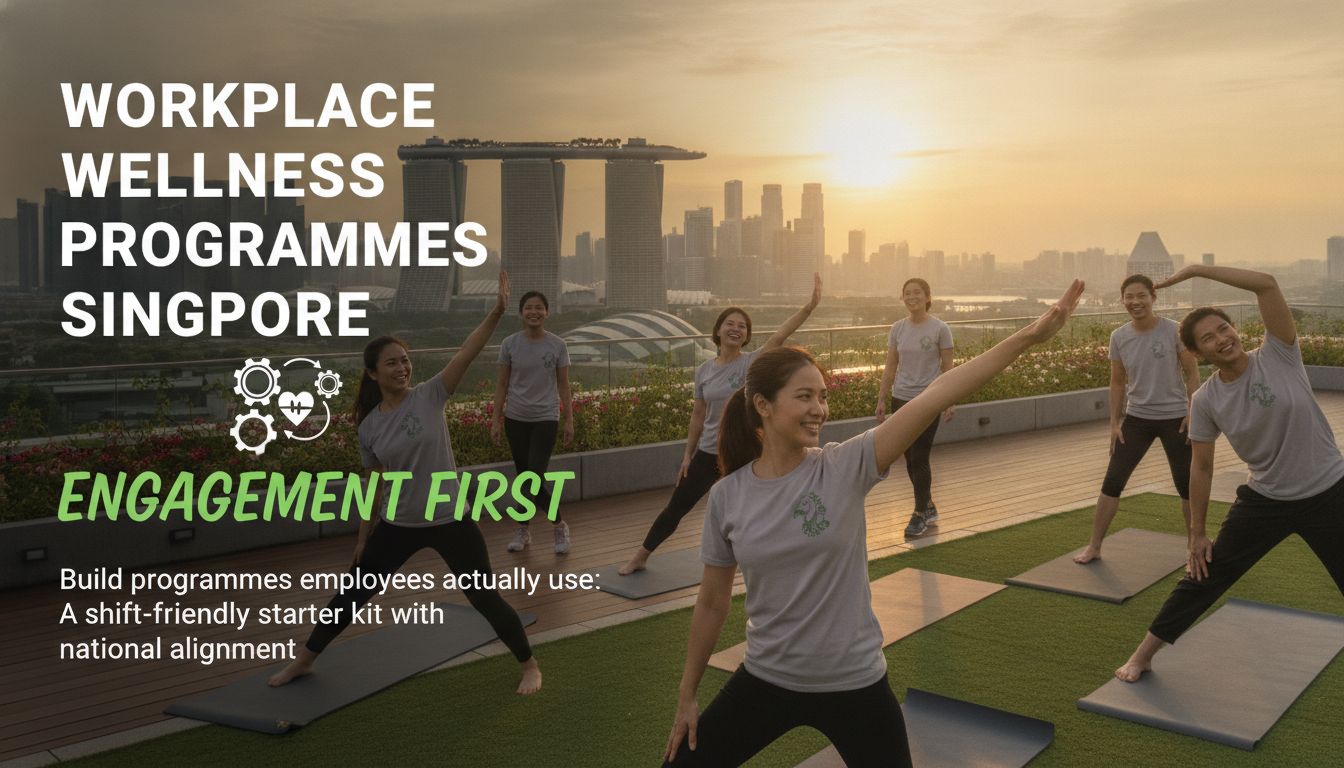
TL;DR: Workplace wellness programmes in Singapore deliver the most value when they run as one strand of a broader employee engagement programme, not as a standalone benefits line. An engagement-led programme combines wellness initiatives, recognition, engagement events and a customised employee portal. Sessions run staggered and on-site so frontline and shift-based employees are reached alongside desk-based teams, aligned with national initiatives such as Healthier SG.
When HR teams research workplace wellness programmes Singapore providers offer, the results tend to look clinical: screening packages, vaccination drives and gym subsidies. Those services have their place, but a list of health services is a benefits line, not a programme. It gets utilised by the employees who were already health-conscious and passes quietly over everyone else.
This guide takes a different starting point: wellness as part of the employee engagement remit. Employees who feel supported have more capacity for discretionary effort, and wellness initiatives can reach shift and frontline employees in a way a single annual event cannot. The sections below cover what an engagement-led wellness programme includes, how to launch it across a large and varied workforce, how it fits an annual calendar alongside Family Day and Dinner & Dance, and where national programmes such as Healthier SG can support the business case. Throughout, the emphasis is on reach: a programme that touches every employee group, sustained by a customised employee portal between set-piece moments.
Table of Contents
- Why Workplace Wellness Programmes in Singapore Need an Engagement Lens
- What an Engagement-Led Wellness Programme Includes
- Launching Across a Large, Heterogeneous Workforce
- Fitting Wellness into the Annual Engagement Calendar
- Aligning with National Health Programmes
- Measuring What Matters
- FAQs on Workplace Wellness Programmes in Singapore
Why Workplace Wellness Programmes in Singapore Need an Engagement Lens
A wellness programme framed purely as healthcare tends to be judged like healthcare: by utilisation and claims data. Framed as engagement, it is judged by whether employees feel that their organisation genuinely supports them, which is the outcome most HR leaders are actually after.
The engagement case for wellness
Gallup's State of the Global Workplace: 2026 Report found that only 20% of employees worldwide were engaged in 2025, only 34% were thriving in their overall wellbeing, and 40% experienced significant stress the previous day. Wellbeing and engagement are measured together for a reason. Employees who feel supported have more capacity for discretionary effort, while employees running on empty conserve energy for getting through the day. Wellness initiatives are therefore not a soft add-on to an engagement programme; they are part of what makes the rest of the programme land.
Where a screenings-only approach falls short
Health screenings, vaccination exercises and gym subsidies are worthwhile, but on their own they behave like insurance: valued in the abstract, rarely experienced as a signal of care. They are also typically opt-in, which means participation skews towards employees who already prioritise their health. An engagement-led programme wraps those clinical services in experiences employees share: workshops, challenges, recognition moments and events that give the programme a visible, social presence in the organisation.
The reach argument
Large Singapore workforces are heterogeneous: frontline, shift-based and desk-based employees working different hours across different sites. A single annual event, however well produced, cannot reach a night-shift technician or a weekend roster team. Wellness initiatives can, because they are modular. A screening session, a stretching class or a wellbeing workshop can be repeated across shifts and delivered on site. That is what makes wellness the workhorse of an engagement calendar: it carries the programme to the employees the big events miss.
What an Engagement-Led Wellness Programme Includes
An engagement-led wellness programme has four working parts: wellness initiatives, recognition, engagement events and an always-on platform that holds them together. Remove any one of them and the programme starts to behave like a benefits line again.
Wellness initiatives, curated rather than improvised
The foundation layer covers physical and mental wellbeing: health screenings, fitness and movement classes, mental wellbeing workshops, and interest-based sessions such as mindfulness or nutrition talks. UPlay for Business curates fitness classes and wellness workshops through a partner network of vetted island-wide providers, coordinated through one point of contact, while health screening is contracted directly with a licensed healthcare provider. That keeps quality consistent across sites without adding five vendor relationships to the HR team's plate.
Recognition woven through the programme
Wellness participation offers an inclusive basis for recognition, giving employees a chance to be recognised regardless of job grade or sales performance. Completing a challenge, joining a screening drive or leading a departmental session are all moments an organisation can acknowledge. Folding recognition into wellness also protects the programme from feeling like compliance; employees are being appreciated, not audited. Broader employee engagement, recognition and wellness programmes work best when these strands are planned together rather than budgeted separately.
Engagement events and an always-on portal
Events create the high points of the programme; the platform keeps it running in between. A customised employee portal lets HR run wellness challenges, publish staggered session schedules, issue recognition and administer rewards across a large workforce from one place, including employees who rarely sit at a desk. For organisations of several hundred to over a thousand employees, the portal is usually what turns a set of good intentions into a programme people can actually find, join and follow.
Launching Across a Large, Heterogeneous Workforce
Before even thinking about the activities, consider accessibility. Planning delivery before content prevents the common failure mode: a well-designed programme that only office-hours employees can attend.
Map the workforce before the calendar
Start with a simple grid: employee groups (frontline, shift-based, desk-based), their sites, their working patterns, and the communication channels that actually reach them. This tells you where on-site delivery is essential, which sessions must repeat across shifts, and where the portal is the only reliable channel. It also surfaces the groups that engagement programmes historically miss, which is where an engagement-led wellness programme earns its keep.
Staggered sessions and on-site delivery
For shift-based and frontline employees, bring the programme to them. Practical patterns include running the same screening or class two or three times across a day to cover shift handovers, holding sessions at the worksite rather than a central office, and keeping each session short enough to fit a break window. Partner-delivered sessions make this practical: the same curated provider can repeat a session across sites and timeslots without HR rebuilding logistics each time.
Build up through engagement layers
Rather than sizing the programme by headcount bands, build it in layers. Start departmental: on-site sessions and workshops within a single business unit, where scheduling is simplest. Add cross-department activity next, such as challenges that connect sites and functions through the portal. Then anchor the year with company-wide milestones, the Family Day and Dinner & Dance moments that the whole organisation shares. Underneath all three sits the always-on platform layer, carrying recognition, rewards and wellness content between events. Each layer reaches employees the previous one could not.
Fitting Wellness into the Annual Engagement Calendar
Wellness initiatives and flagship events are complements, not competitors: the events create shared memories, and wellness keeps the programme present in the months between. The annual calendar should showcase both.
Anchor events: Family Day and Dinner & Dance
A Family Day recognises employees through the people they care about, and a year-end Dinner & Dance closes the year with celebration and awards. Both are natural hosts for wellness content: activity stations and family-friendly movement at a Family Day, or a wellbeing-themed segment in a D&D programme. For large-format events, D'Marquee at Downtown East offers a 2,400 sqm pillarless, air-conditioned space, with the Begonia Ballroom, Cassia and Aster rooms in the same precinct for smaller sessions and Wild Wild Wet next door as a Family Day option, without the CBD or Marina Bay venue premium.
The months in between
Between anchors, the programme runs on the departmental and cross-department layers: quarterly screening or class cycles rotated across sites, wellbeing workshops timed away from peak operational periods, and portal-based challenges that need no physical gathering at all. A workable rhythm looks like this:
| Period | Engagement layer | Example touchpoints |
|---|---|---|
| Q1 | Departmental | On-site screenings and classes, staggered by shift and site |
| Q2 | Company-wide milestone | Family Day with wellness and activity stations |
| Q3 | Cross-department | Portal-run challenges and workshops connecting sites |
| Q4 | Company-wide milestone | Dinner & Dance with recognition and awards segment |
| Year-round | Always-on platform | Customised employee portal: recognition, rewards, wellness content |
If you are planning next year's calendar and want to see how other large Singapore organisations have structured theirs, browse the case studies or request a package quote to map the options against your sites and shift patterns.
Aligning with National Health Programmes
Aligning your wellness programme with national initiatives strengthens the sign-off case, because HR can show the programme supports publicly backed health priorities rather than a standalone spend. Three are worth naming in a proposal.
Healthier SG in the workplace
Under Healthier SG, the Ministry of Health has encouraged employers to support preventive care, including ensuring company medical panels include Healthier SG clinics and granting employees time off for health consultations and screenings. A wellness programme that already schedules on-site screenings and normalises preventive care sits squarely within this direction.
Health Promotion Board workplace resources
The Health Promotion Board runs a Healthy Workplace Ecosystem initiative, partnering landlords and developers to bring free exercise sessions, health talks, health coaching and healthier food options to workplaces, with employees signing up through the Healthy365 app. HPB resources can complement an employer-run programme, particularly for desk-based teams in participating buildings.
Total Workplace Safety and Health
The Workplace Safety and Health Council's Total WSH programme treats safety, occupational health and wellbeing as one agenda, pairing companies with appointed providers to assess needs and implement interventions. For workforces with significant frontline and operational populations, framing wellness within Total WSH connects the programme to safety outcomes leadership already tracks.
Measuring What Matters
Measure an engagement-led wellness programme on reach and engagement signals first, clinical outcomes second. Clinical indicators move slowly and sit with healthcare providers; reach is what HR controls and what the engagement case rests on.
Reach and participation across employee groups
Track participation by employee group, site and shift, not just in total. A headline participation rate can mask an uneven turnout, particularly if participation is concentrated among desk-based employees. For a workforce spanning different roles and work patterns, the real measure of progress is whether participation gaps between frontline, shift-based and office-based employees are narrowing over time. Portal data makes this visible without manual surveys.
Engagement signals and feedback
Pair participation data with engagement signals: recognition activity linked to wellness, repeat attendance, session feedback scores and movement in the wellbeing questions of your engagement survey. Organisations should treat these as directional evidence rather than proof of causation, but a programme that shows growing, broadening participation alongside improving sentiment gives finance and leadership something concrete at renewal time.
FAQs on Workplace Wellness Programmes in Singapore
What should a workplace wellness programme in Singapore include?
An engagement-led programme includes four parts: wellness initiatives such as health screenings, fitness classes and wellbeing workshops; recognition tied to participation; engagement events such as Family Day and Dinner & Dance; and an always-on portal that administers schedules, recognition and rewards. The mix should be planned as one programme rather than separate budget lines.
How do companies deliver wellness programmes to shift and frontline employees?
Deliver on site and stagger the schedule. Repeat the same screening or class across shifts, hold sessions at the worksite in slots that fit break windows, and use a portal rather than email as the channel for schedules and sign-ups. Modular, partner-delivered sessions make it practical to repeat the same activity across sites and timeslots.
Are there national programmes that support workplace wellness in Singapore?
Yes. Healthier SG encourages employers to support preventive care, including time off for consultations and screenings; the Health Promotion Board's Healthy Workplace Ecosystem brings free exercise sessions, health talks and coaching to participating workplaces; and the WSH Council's Total WSH programme helps companies address safety, health and wellbeing as one agenda.
What is the difference between a wellness programme and an employee engagement programme?
A wellness programme focuses on physical and mental wellbeing initiatives, while an employee engagement programme is the broader effort spanning recognition, events, communication and growth. Wellness works best as one strand of the engagement programme, because it reaches employee groups that single events cannot and gives the engagement calendar year-round presence.
How do you measure the success of a workplace wellness programme?
Track reach first: participation by employee group, site and shift, with particular attention to frontline and shift-based uptake. Add engagement signals such as repeat attendance, session feedback and wellbeing questions in the engagement survey. Treat clinical outcomes as a longer-term indicator that sits with healthcare providers rather than the programme's primary scorecard.
Putting the Starter Kit to Work
The reframe the whole guide rests on: treat wellness as engagement infrastructure, not a benefits line. Map your workforce, build up through the engagement layers, anchor the year with Family Day and Dinner & Dance, keep the months between alive with staggered, on-site wellness initiatives, and let a customised employee portal carry recognition and rewards throughout. Align the proposal with Healthier SG and Total WSH so the sign-off conversation starts from national priorities rather than a cold budget request. From employee recognition and wellness programmes to Family Days, Dinner & Dance celebrations and workforce engagement solutions, UPlay for Business helps organisations deliver meaningful experiences at scale while reducing administrative effort for HR teams. Request a Package Quote to plan a programme around your sites and shifts, or see how other companies did it in our case studies.