
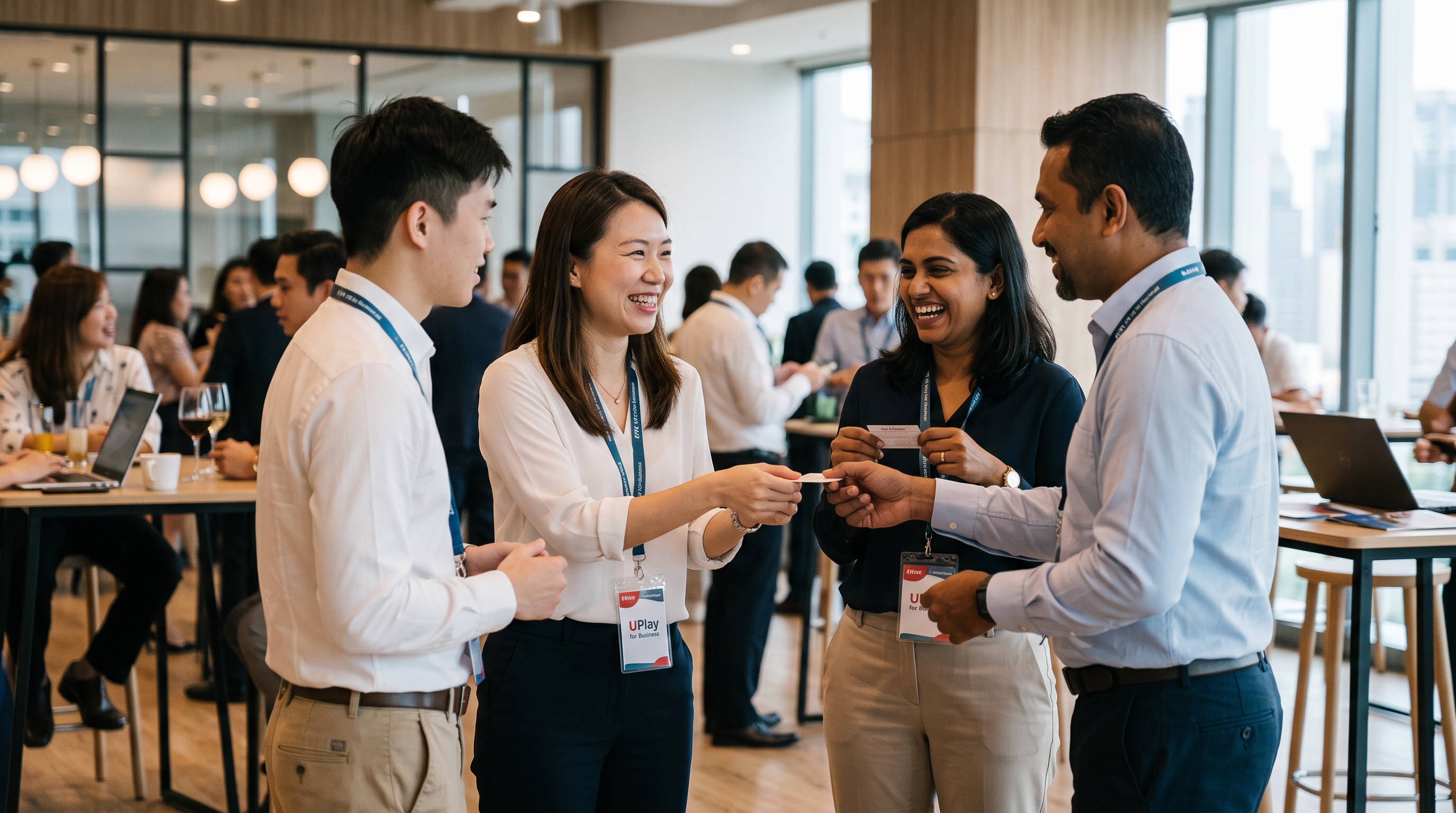
Heads of people and HR business partners in large Singapore organisations face a steady stream of questions that no policy manual answers in time: how a new tripartite guideline applies to a rostered frontline team, whether a recognition programme that worked for desk-based employees will travel to shift-based sites, which venue can hold 800 people without a city-centre premium. Desk research produces options. A phone call to a peer who solved the same problem last quarter produces a decision.
That is the case for the HR professional network, and it is why the HR leaders who handle new questions with the least friction are often the ones still adding to their circle. This article reveals the research on professional networks, the large-workforce problems peers solve faster than search engines, the importance of expanding the circle, and a practical cadence for expanding it without a second job. It closes with how to convert a peer’s answer into action across an organisation of 500+ onwards, from a departmental pilot to a customised employee portal that keeps the outcome running year-round.
What an HR Professional Network Is and Why Senior Leaders Invest in It
An HR professional network is the set of peers, former colleagues, industry-body contacts, advisers and vendors an HR leader can call on for advice, references and a candid second opinion. Its value lies less in how many people it contains than in how many different problems those people have already solved.
A working definition for HR leaders
The useful test is practical: when a new obligation, engagement gap or budget question lands on the desk, how many people can the HR leader message today who have already dealt with it in a comparable organisation? A network that passes this test spans several industries, multiple company sizes and both operational and corporate HR roles, rather than one tight group in the same sector.
What the research on networks shows
Sociologist Mark Granovetter’s 1973 paper on the strength of weak ties found that acquaintances, not close friends, were the more useful source of job information for the 282 men he surveyed, because weak ties reach into circles the individual does not already know. Nearly fifty years later, a randomised experiment on more than 20 million LinkedIn members, published in Science in 2022, confirmed that moderately weak ties did more for job mobility than strong ones.
The same pattern holds for ideas. Ronald Burt’s study of 673 supply-chain managers at a large electronics firm found that managers whose networks bridged separate groups were more likely to have their ideas judged valuable, because they could see options invisible from inside any single group. In Harvard Business Review, Rob Cross and Robert Thomas reported from fifteen years of work with more than 300 companies that executives ranking in the top 20 per cent of their organisations for both performance and wellbeing held diverse but select networks, while people who simply knew a lot of people were less likely to achieve standout performance. Breadth is what senior HR leaders are investing in.
Problems an HR Professional Network Solves Faster Than Desk Research
Peers solve a specific class of problem faster than research: questions where the answer depends on context that no published guide can supply. Four categories come up repeatedly for large Singapore workforces.
Interpreting new employment obligations
Singapore’s employment framework is moving quickly. Parliament passed the Workplace Fairness Act in January 2025, with written grievance-handling procedures among the obligations employers must prepare for ahead of commencement. The Tripartite Guidelines on Flexible Work Arrangement Requests have applied since 1 December 2024. From 1 July 2026, the retirement and re-employment ages rose to 64 and 69, as announced at the Ministry of Manpower’s Committee of Supply 2026. The published text of each change is available to everyone; what a peer supplies is how it plays out with a rostered workforce and which interpretation their legal counsel accepted.
Engaging a multi-generational, heterogeneous workforce
With re-employment extending to 69 years old, many large organisations may now employ four generations across frontline, shift-based and desk-based roles on different sites and schedules. A peer who runs engagement for a similar mix can vouch for formats that reached night-shift technicians, share recognition gestures that older employees valued and confirm staggered-session schedules that operations managers accepted.
Sustaining engagement between annual events
A Family Day and a Dinner & Dance anchor many large-company calendars, but engagement should be year-round, while events are amplifiers of it. Peers are often the quickest source of answers on what sits between the anchors: how another organisation structures peer recognition across sites, how it administers wellness sign-ups for shift employees, and how it keeps employee engagement, recognition and wellness programmes visible in the quieter months.
Vendor, venue and programme references
Before an HR leader commits budget to a venue that must hold 800 people, or to a recognition platform that must serve several thousand employees, a peer’s account of how the same supplier performed carries more weight than any brochure.
Why the Circle Must Keep Expanding
A network built five years ago answers five-year-old questions. Senior HR leaders keep widening the circle because the problems, the industries and the peer set are ever changing.
Problems change faster than networks do
Five years ago, few HR leaders in Singapore had drafted a flexible work request policy or planned re-employment for a 69-year-old. The peers who can advise on those questions today were often in nobody’s circle in 2021. Cross and Thomas describe the biased leader who relies on advisers with the same background and location, and therefore receives the same advice however the question changes. Expanding the circle is the structural remedy.
Industries converge on the same people problems
A logistics operator, a hospital group and a retail chain now share a set of problems: multi-site rosters, an ageing frontline, recognition that must work on a phone rather than a noticeboard. CIPD commentary has noted that HR professionals in Singapore and Hong Kong under-use cross-industry networking and are often absent from chambers of commerce and other mixed-sector forums. A circle limited to one’s own sector leaves the most transferable solutions out of reach.
Diversity within the large-workforce peer set
Among organisations of 500+ onwards, the peer set itself is diverse: statutory boards, unionised manufacturers, hospitality groups, financial institutions. Each has solved a different subset of the problems above. Burt’s finding applies directly: the HR leader whose circle includes a public-sector counterpart and a hospitality counterpart sees two solutions to a rostering problem where a single-sector circle sees one.
How Top HR Leaders Expand the Circle Without a Second Job
Expanding a network is a matter of cadence and reciprocity rather than volume. Four habits recur among HR leaders who do it well.
One exchange-format event a quarter
Small, discussion-led sessions often add more usable contacts than large conferences, because attendees have time to talk. The SHRM guidance on HR networking suggests setting a small, specific goal, such as a fixed number of events a year; one exchange-format event a quarter is a realistic target for a busy head of people.
The HR Exchange Series by UPlay for Business exists for exactly this purpose. Its next session, HR Breakfast Exchange: Where Inclusive Leadership Meets Employment Law, takes place on Friday, 16 October 2026, from 4.00pm to 6.00pm at Bloom & Boom, 201 Victoria Street #07-04 (registration opens 3.30pm). The afternoon session covers leading a multi-generational workforce inclusively, challenging age-based assumptions, building resilience and engagement, practical engagement strategies that foster belonging, and how evolving employment law shapes workplace obligations. Afternoon tea and a complimentary scented candle-making session give attendees unhurried time to compare notes, which is where the useful contacts come from.
Reciprocity: answer two questions for every one asked
Networks that last, run on giving first. HR leaders who readily share a template, a vendor contact or a lesson learned find their own questions answered quickly in return. A workable rule is to answer two peer questions for every one asked.
Follow up within 48 hours and use the institutions
A contact made at an event decays quickly without a follow-up. Sending a short note within 48 hours, with the item promised during the conversation, converts an introduction into a working tie. Singapore’s professional bodies extend the reach further: the Singapore Human Resources Institute (SHRI), established in 1965, and the Institute for Human Resource Professionals (IHRP), set up by the tripartite partners to administer the national HR certification, both run member communities and events where HR practitioners from different sectors meet.
Tip: Keep a simple record of who in the circle has tackled specific challenges before. When a new obligation or engagement question arrives, the record turns a vague sense that “someone mentioned this” into a specific person to call.
Turning a Peer Answer Into Action Across a Large Workforce
A peer’s answer is a starting point. Inside an organisation of 500+ onwards, the answer needs to move through three engagement layers before it counts as solved.
Test at the departmental layer
Pilot the borrowed idea, whether a recognition format, a wellness initiative or an appreciation session, with one department or site that resembles the peer’s context. A departmental session for a single shift-based team surfaces scheduling and delivery problems quickly, and gives HR local evidence to present.
Scale across departments to a company-wide milestone
Once the pilot holds, extend it across departments with the same format and message, then attach it to a company-wide milestone so the whole workforce experiences it together. This is where operating scale matters: UPlay for Business coordinates recognition and wellness programmes curated via its partner network, together with attendance tracking, transport from multiple work sites and facilitator scheduling, and negotiates bulk rates across a whole programme rather than the per-person prices a studio quotes directly. Its case studies show how other large Singapore organisations have run the same progression.
Sustain it on an always-on platform
Programmes borrowed from peers fade without an administrative home. A customised employee portal gives HR one place to run recognition, issue rewards and manage sign-ups across every site and shift, so the initiative continues between milestones rather than resetting each year. It also produces the participation data HR leaders bring back to their circle, which completes the loop: the organisation that borrowed an answer becomes the one others call.
FAQs on Building an HR Professional Network
What is an HR professional network?
An HR professional network is the set of peers, industry-body contacts, advisers and vendors an HR leader can call on for advice, references and second opinions. Research on professional networks, from Granovetter to Cross and Thomas, points to breadth across industries and roles, rather than size, with regards to solving problems effectively.
Why is networking important for HR professionals?
Many HR problems depend on context that published guidance cannot supply: how a new employment obligation applies to a rostered workforce, or which recognition format reached shift-based employees elsewhere. A peer who has already solved the problem shortens the path from question to workable decision.
How do busy HR leaders find time to network?
A cadence works better than good intentions: one exchange-format event a quarter, a follow-up note within 48 hours of each new contact, and a habit of answering peer questions promptly so that the circle reciprocates. Discussion-led sessions such as the HR Exchange Series by UPlay for Business are designed to fit a single afternoon.
Which HR networks and bodies operate in Singapore?
The Singapore Human Resources Institute (SHRI), founded in 1965, and the Institute for Human Resource Professionals (IHRP), established by the tripartite partners, both run communities and events for HR practitioners. Employer-organised exchanges, including the HR Exchange Series by UPlay for Business, add a format built around practical peer discussion on engagement and employment law.
Keeping the Circle Open
A strong HR professional network turns a new obligation or engagement gap into a decision that peers have already tested, and it stays useful only if it keeps expanding in our ever-evolving landscape. The HR Breakfast Exchange: Where Inclusive Leadership Meets Employment Law on Friday, 16 October 2026 presents the perfect opportunity to add peers; places can be reserved through the event page. From employee recognition and wellness programmes to Family Days, Dinner & Dance celebrations and workforce engagement solutions, UPlay for Business helps organisations deliver meaningful experiences at scale while reducing administrative effort for HR teams. To put a peer’s answer into practice across your own workforce, Request a Package Quote.