

HR and people-team leaders in large Singapore organisations rarely lack ideas for employee engagement. What they lack is evidence about which ideas survive contact with a workforce of 500+ onwards, spread across shifts, sites and generations. HR networking events close that gap faster than desk research, because the person across the table has already been through the same challenges.
Most attendees, however, leave with business cards and a few slogans rather than transferable practice. This article sets out a blueprint for changing that: why peer exchange outperforms desk research, how to prepare two or three live problems before the event, which questions get useful answers on the day, how to convert notes into a one-page practice card and test it, and how sharing your own results with peers builds a network you can rely on. It closes with common practices at HR exchanges in Singapore, organised by engagement layer, from departmental sessions to an always-on customised employee portal.
Why Peer Exchange Outperforms Desk Research on Engagement Practices
Peer exchange gives HR leaders something published research and vendor case studies cannot: an honest account of how a practice performed in an organisation with a comparable headcount, workforce mix and regulatory context. Desk research tells you what is possible; a peer tells you what it cost and what did not work. An exchange format, with a shared theme and a group, can be more effective than a conference stage.
Singapore’s engagement picture raises the value of local benchmarks
The inaugural Singapore Workplace Report 2026, published by the Singapore Institute of Directors and Gallup, found that only 14 per cent of Singapore’s workforce is engaged, below the Southeast Asia figure of 25 per cent and the global mean of 20 per cent, and essentially unchanged since 2019. The same report found a six-point engagement gap between employees under 35 and those aged 35 and over, roughly three times the global gap of two points. Practices that have narrowed that gap in one Singapore organisation are worth more to a local HR leader than a global average.
What research says about learning from peers
Communities of practice are the formal version of what a good HR exchange does informally. A 2023 scoping review defines them as groups who share a common interest in a practice or problem. Their activities share best practice and create knowledge to advance it. A 2025 qualitative study of hospital managers in BMC Research Notes found that participants credited peer learning with improving their decision-making, managerial performance and inter-organisational interactions, while restricted structured interaction limited its effectiveness. Structure separates a useful exchange from a pleasant one.
Before the Event: Choose the Problems Worth Solving
Preparation determines what you take home. Two or three specific, live problems turn every conversation into a targeted enquiry instead of a general chat.
Pick two or three live problems
Choose problems your leadership team already recognises, so any borrowed practice has a sponsor waiting. Common examples for large, heterogeneous workforces:
- Reaching shift-based and frontline employees with recognition when most activity happens at head office.
- Sustaining engagement between company-wide anchors such as Family Day and Dinner & Dance.
- Delivering wellness initiatives that reach every site and shift window.
- Engaging a multi-generational workforce without age-based assumptions about what each cohort wants.
Write the questions that surface how others handle them
For each problem, draft two or three questions that ask for mechanics rather than opinions. “How do you get recognition to your night shift workers?” produces a more useful answer than “Do you find that recognition works?” Questions about who administers a programme, how often it runs and what it costs per head translate directly into a proposal.
Know your own baseline numbers
Bring your own figures: participation rates by site and shift, recognition frequency, wellness sign-ups, event attendance across employee groups. Peers share more readily with someone who can reciprocate with specifics, and a baseline is a great way to judge whether a practice is worth borrowing.
At HR Networking Events: Questions That Get Useful Answers
The most useful conversations at HR networking events move past the highlight reel to the operating detail. Four questions do most of the work.
Four questions that move past the highlight reel
- What did you try first, and what did you change? The first version of a programme is rarely the one that worked; the revisions reveal the constraints you will also meet.
- What did you stop doing? Discontinued initiatives are the most candid data an HR leader can offer, and the least likely to appear in a case study.
- How do you measure it? Ask for the actual metric, its frequency and who sees it. Gallup reports that variation in whether employees received recognition or praise in the last seven days accounts for a 10 to 20 per cent difference in revenue and productivity, so a peer who tracks recognition frequency by site is measuring something that matters.
- How do you reach employees who are not at a desk? A practice that only works for desk-based employees is half a practice for a workforce of 500+ onwards. Ask about staggered sessions, on-site delivery and mobile access.
Give as much as you take
Peer exchange runs on reciprocity. Offer your own stopped initiatives, your participation numbers and the constraint that surprised you. Attendees who share candidly receive candid answers in return.
Use the event’s themes as a shared agenda
Exchange-format events with defined themes make comparison easier because every attendee has considered the same questions in advance. The HR Breakfast Exchange: Where Inclusive Leadership Meets Employment Law, part of the HR Exchange Series by UPlay for Business, is one example. The afternoon session on Friday, 16 October 2026 (4.00pm to 6.00pm, registration from 3.30pm) at Bloom & Boom, 201 Victoria Street, sets its agenda around leading a multi-generational workforce inclusively, challenging age-based assumptions, building resilience and engagement, practical engagement strategies that foster belonging, and how evolving employment law shapes workplace obligations. Those themes give attendees a ready-made list of practices to compare, and the afternoon tea and complimentary scented candle-making session let the conversation continue informally.
The employment-law theme is timely. Singapore’s Workplace Fairness Act, passed by Parliament in January 2025, will prohibit adverse employment decisions based on protected characteristics including age, with the Tripartite Guidelines on Fair Employment Practices continuing to cover other characteristics. Engagement practices built on age-based assumptions are worth re-examining now, and peers who have already done so are a useful source.
After the Event: Turn Notes Into a Practice Card
Value from an exchange decays quickly unless captured within a day or two. A short, standard format keeps borrowed ideas comparable and ready for a sponsor conversation.
The one-page practice card
For each idea worth pursuing, complete a single page with the following fields:
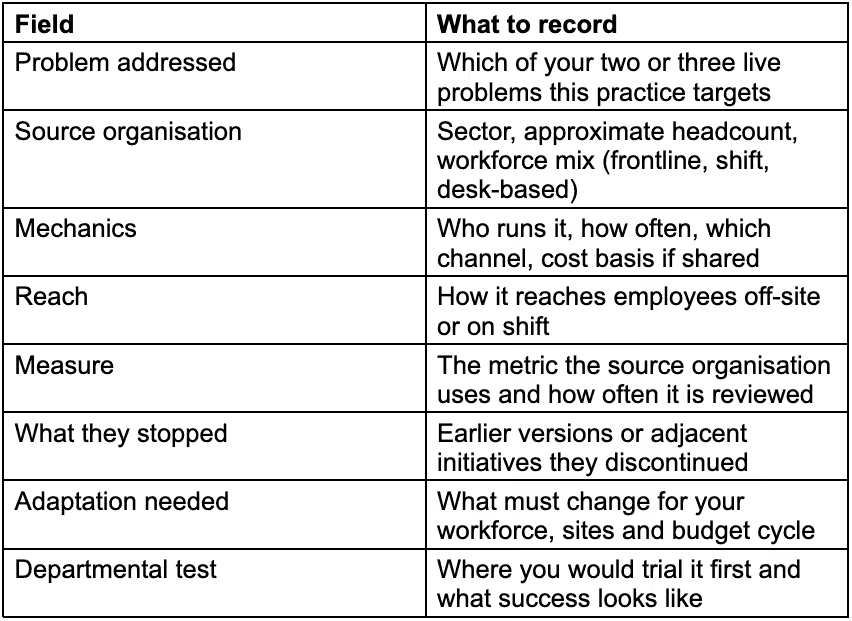
Test at departmental level before scaling
Trial one practice in a single department or site, preferably one that includes shift-based or frontline employees, before proposing it company-wide. A departmental test surfaces scheduling and administrative issues at a scale where they can be fixed, and produces the participation data that makes a company-wide proposal credible at budget time.
Adapt rather than copy
There is no one-size-fits-all solution; a practice that works in one organisation may need adjusting in another. Borrow the principle, adjust the mechanics, and keep the measure so you can compare your result with the source organisation’s.
Tip: If a borrowed practice depends on wellness workshops or recognition rewards, confirm early whether they can be curated via a partner network, so the departmental test does not stall on vendor sourcing.
Sharing Back: Why Generosity Builds a Network That Answers
A network that answers your questions next time is built by answering theirs this time.
What to share
Share the departmental test result, whether or not it succeeded; a trial that failed for a specific, explainable reason is as useful to peers as one that worked. Add the adaptation you made and why, the metric you tracked, and any partner or administrative arrangement that made delivery easier across sites and shifts.
How to share it
A short message to the peer who gave you the idea, a follow-up at the next event in the series, or a summary circulated to the group are all effective. Mention when a practice aligns with national programmes, for example development initiatives that tap on SkillsFuture. This helps the next HR leader justify the spend at sign-off and pairs the employee benefit with the organisational one. Documented programmes, such as the case studies of what other companies did, often become the starting point for the next exchange conversation.
Practices That Circulate at HR Networking Events in Singapore
The practices HR leaders compare most often at exchanges in Singapore fall into four engagement layers. Framing them by layer keeps the focus on how engagement reaches employees.
Departmental layer
Departmental appreciation sessions run as a staggered series across shifts and sites, so operations employees receive the same gesture in the same month as corporate functions. Peers compare how they keep the format consistent across sessions and schedule around shift handovers.
Cross-department layer
Peer-appreciation channels that let recognition travel between colleagues who never share an office, and wellness initiatives such as step challenges or repeated wellbeing workshops that run across every site. These programmes sit within a broader employee engagement, recognition and wellness calendar. Facilitators come curated via a partner network, so HR coordinates one programme instead of sourcing vendors site by site. Booking across a whole programme also secures rates that a single studio approached directly rarely offers.
Company-wide milestone layer
Family Day and Dinner & Dance are two anchors that many large Singapore organisations plan around, working as amplifiers on top of everyday engagement efforts. At exchanges, the comparison usually turns on inclusion: how organisations run multi-session formats so operations coverage holds while every employee attends, and how they present long-service and values-based awards in person rather than by post.
Always-on platform layer
The practice that draws the most questions is how organisations keep recognition and rewards running between events. A customised employee portal gives HR one place to issue recognition, administer rewards and run wellness sign-ups across the whole workforce, including employees who never sit at a company desk. Because each organisation customises its own portal, peers compare which functions they run through the portal and how much site-by-site coordination the portal has replaced. To scope this layer for your own workforce, request a package quote.
FAQs on HR Networking Events
What are HR networking events?
HR networking events are gatherings where HR and people-team professionals from different organisations meet to exchange practices, benchmark programmes and discuss shared challenges such as engagement, wellbeing, productivity and employment law. Formats range from large conferences to small exchange sessions built around a theme.
How do HR leaders benefit from networking events?
HR leaders gain first-hand accounts of how comparable organisations run engagement and wellbeing programmes, including what they discontinued and how they measure results, which helps HR build proposals that leadership and finance will recognise as tested rather than theoretical.
What questions should HR professionals ask at networking events?
Ask what a peer tried first and changed, what they stopped doing, how they measure the programme and how it reaches employees who are not at a desk. Questions about mechanics, administration and cost basis produce answers that become proposals. The main benefit is evidence: HR can present leadership and finance with a practice that a comparable organisation has already tested.
How do you apply what you learn at HR networking events?
Capture each idea on a one-page practice card within a day or two, test one practice at departmental level with a defined metric, adapt the mechanics to your own workforce and budget cycle, and share the result back with the peer who gave you the idea. Company-wide scaling follows a successful departmental test.
Building Your Own HR Exchange Blueprint
The blueprint is simple to repeat: arrive with two or three live problems, ask about failures and measurement, capture each idea on a practice card, test at departmental level, adapt rather than copy, and share the result back. Applied consistently, it turns HR networking events from a calendar obligation into a reliable source of tested engagement and productivity practice for a large workforce. The next opportunity to put it to work is the HR Breakfast Exchange: Where Inclusive Leadership Meets Employment Law on Friday, 16 October 2026, an afternoon session in the HR Exchange Series by UPlay for Business. From employee recognition and wellness programmes to Family Days, Dinner & Dance celebrations and workforce engagement solutions, UPlay for Business helps organisations deliver meaningful experiences at scale while reducing administrative effort for HR teams. Request a Package Quote to turn the practices you bring back into a programme that reaches every employee.