
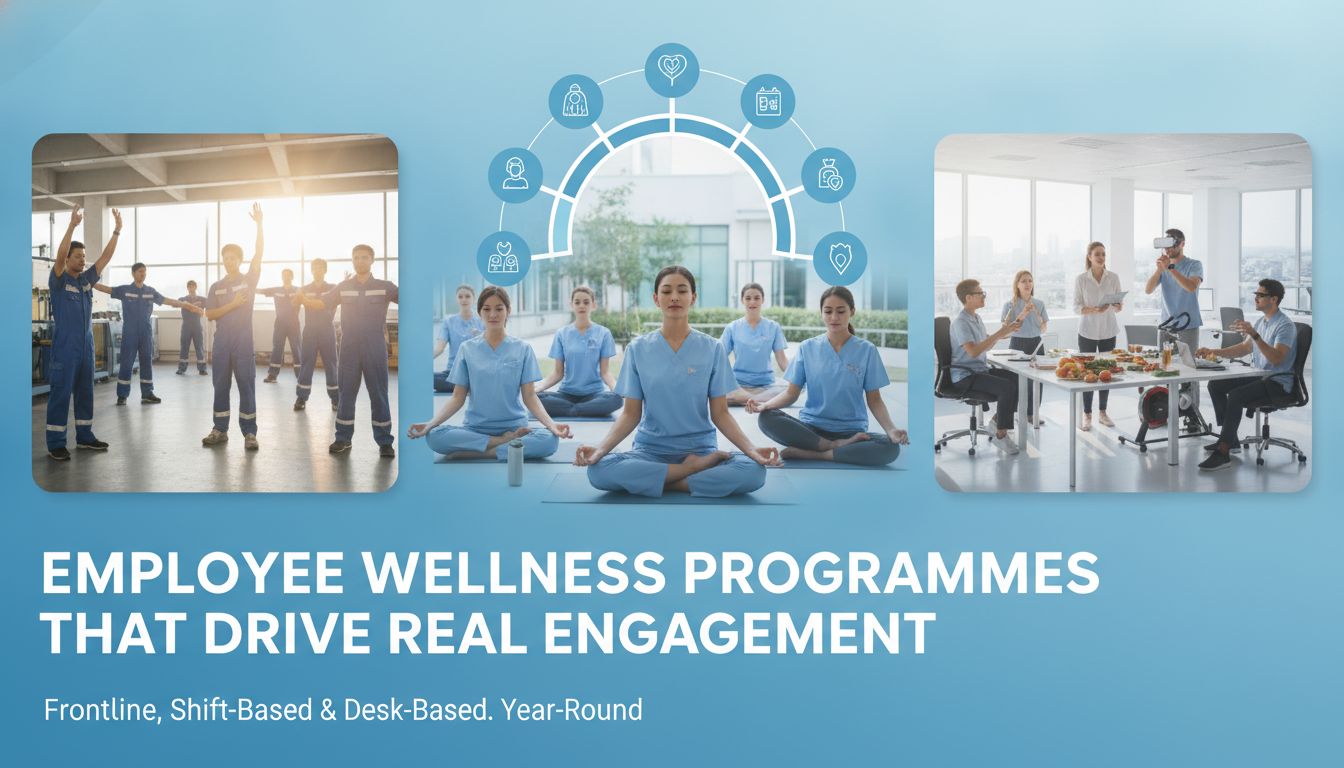
TL;DR: Employee wellness programmes achieve real uptake when they run as part of an employee engagement strategy, not as a standalone benefits line. That means selecting components a diverse workforce can genuinely attend (on-site fitness sessions, health screenings, wellbeing workshops), scheduling them around shift patterns, and connecting them to recognition and a year-round calendar through a customised employee portal.
Employee wellness programmes are often approved readily, yet uptake can be a different matter. HR teams secure budget, launch a fitness class or a screening day, and yet, sign-ups may plateau among the same small group of desk-based volunteers. This could signal that wellness was bolted on as a benefits line rather than built into how the organisation engages its people.
This guide takes a component-by-component look at wellness through an engagement lens: which activities employees across a large, heterogeneous workforce actually take up, why participation collapses when wellness sits in isolation, and how to fold wellness into a year-round engagement calendar alongside recognition, engagement events and an always-on customised employee portal. The aim is a programme that frontline, shift-based and desk-based employees all experience.
Table of Contents
- Why Wellness Belongs in the Engagement Remit
- Why Employee Wellness Programmes Fail at Uptake
- Programme Components Employees Genuinely Take Up
- Designing for Frontline, Shift-Based and Desk-Based Employees
- Building Wellness into a Year-Round Engagement Calendar
- Measuring Uptake and Justifying the Spend
- FAQs on Employee Wellness Programmes
- Bringing Wellness and Engagement Together
Why Wellness Belongs in the Engagement Remit
Workplace wellness also sits in line with Singapore's national initiatives on health and wellness, which helps when the programme goes for approval. Wellness drives engagement because employees who feel genuinely supported have the capacity for discretionary effort, and because wellness activities reach shift and frontline employees in a way a single annual event cannot. Treating wellness as a benefits line item, something employees may claim if they find the time, is what separates programmes with strong participation from programmes that exist only on paper.
Supported employees are engaged employees
According to Gallup research from 2024, 89% of employees do not feel their company truly cares about their wellbeing. A wellness programme that visibly reaches every employee group signals care and reflects well on engagement surveys.
Wellness reaches employees a single event cannot
An annual Dinner & Dance or Family Day is a powerful engagement moment, but it is one or two dates in a calendar year. Wellness activities, by contrast, can run monthly or weekly, on-site, across shifts. For a large workforce spread over different sites and schedules, wellness is often one of the few engagement touchpoints that can plausibly reach everyone between the flagship events.
The remit shapes the design
When wellness sits with engagement, its success measure changes from "did we offer it" to "who took it up". That shift drives better decisions about scheduling, communication and follow-through, which the rest of this guide works through component by component.
Why Employee Wellness Programmes Fail at Uptake
Most wellness programmes fail at uptake for structural reasons. Three failure patterns appear repeatedly, and all three trace back to wellness being bolted on rather than designed in.
Designed around desk-based schedules
A lunchtime yoga class at headquarters assumes an employee who works near headquarters and controls their lunch hour. Frontline and shift-based employees, who often make up the majority of a large workforce, may never be able to attend a single session. When a programme is only accessible to office-based employees, overall participation figures stay low no matter how good the activity is.
Communicated once, then forgotten
Organisations may observe that a programme launched with an email announcement fades from awareness within weeks. Employees without regular access to a work inbox, common among frontline teams, may never learn the programme exists at all. Without a persistent, accessible channel that reaches every employee, even well-designed activities go under-used.
Disconnected from everything else
A standalone wellness programme competes for attention against every other demand on an employee's time, with nothing reinforcing it. When wellness connects to recognition (participation is acknowledged), to events (activities feed into the company calendar) and to an always-on platform (one place to see and book everything), each element reinforces the others.
Programme Components Employees Genuinely Take Up
The components that earn real participation share two traits: they come to the employee and they require little planning effort from the participant. UPlay for Business curates the activities below via our partner network of vetted providers, coordinated through a single point of contact to save time and effort.
1. On-site fitness and movement sessions
Group fitness classes, guided stretching and low-impact movement sessions, delivered at the workplace, remove the two biggest barriers to exercise: travel time and inertia. Curated via our partner network, these work best as a repeating series, with session times rotated so different shifts each get accessible slots.
2. Health screenings brought to the workplace
Basic health screenings are consistently among the most-used wellness components due to time efficiency and because the value is immediate and personal. Arranged with a licensed healthcare provider and run on-site across multiple time bands, screenings also give shift-based employees a benefit they can actually reach.
3. Mental wellbeing talks and workshops
Practical sessions on stress management, sleep and mental wellbeing acknowledge the pressures employees carry without singling anyone out. Education matters here in its own right: employees who understand how stress, sleep and mood interact are far better placed to manage their own mental health, and to notice when a colleague is struggling. Delivered by partner-network professionals in a workshop format, they sit comfortably alongside creative sessions such as art jamming or terrarium-making, which offer a lighter route into the same conversation about switching off and recharging.
4. Wellness challenges with recognition attached
Step challenges and team-based activity challenges, run over two to four weeks, give employees a shared goal and provide HR with a steady stream of recognition moments. The design detail that matters is rewarding participation, not only winners, so employees at every fitness level have a reason to stay. These sit naturally within a broader employee engagement, recognition and wellness programme.
If you are weighing which components fit your workforce and sites, request a package quote to talk through options against your headcount and shift patterns, or see how other companies did it first.
Designing for Frontline, Shift-Based and Desk-Based Employees
For a large workforce, the reach of a wellness programme is largely determined by how well it serves employees who do not sit at a desk. Designing for the hardest-to-reach group first is one of the most reliable ways to lift overall uptake.
Stagger and repeat every session
Where an activity can practically be repeated, running it more than once increases attendance: a morning slot, an afternoon slot and a slot aligned to shift handovers. Repeating sessions across time bands costs less than it appears, because partner providers can deliver back-to-back sessions on the same visit, and it affects who can attend.
Deliver on-site, at every site
Convenience and accessibility can make a considerable difference to uptake. For organisations operating across multiple locations, that means bringing screenings, classes and workshops to each site on a rotating schedule. Off-site anchor moments still have their place; the point is that the everyday layer should travel to the employee.
Frame by engagement layer, not headcount
Plan wellness in layers: departmental activities that fit naturally into a team's rhythm, cross-department challenges that connect silos, company-wide milestone events that unify everyone, and an always-on platform underneath it all. Each layer reaches employees another might miss, and together they cover the whole workforce.
Building Wellness into a Year-Round Engagement Calendar
Wellness sustains engagement when it runs as a rhythm. The organisations that see durable participation treat wellness as one strand of a year-round engagement calendar, woven together with recognition and flagship events.
Let flagship events amplify the everyday layer
A Family Day or Dinner & Dance sits on top of everyday engagement efforts. Flagship events work better when they connect to the wellness rhythm: a Family Day can close out a company-wide activity challenge, and a D&D awards segment can recognise the teams that showed up all year. The event becomes proof that the everyday programme mattered.
Tie participation to recognition
Acknowledging wellness participation, through shout-outs, milestone badges or awards at company events, turns a private habit into a visible part of workplace culture. It also gives managers of frontline teams a concrete, low-cost way to recognise employees between formal review cycles, and it lets those employees feel seen and valued.
Run it all through a customised employee portal
Administering wellness, recognition and event sign-ups across thousands of employees on different schedules is genuine work, and it is where many programmes quietly stall. A customised employee portal gives every employee, on any shift and at any site, one place to discover activities, book sessions and receive recognition, and gives HR one place to run the calendar and track uptake. For a large workforce, this always-on layer is what converts a series of one-off activities into a programme.
Measuring Uptake and Justifying the Spend
Beyond total participation, monitor participation by employee group as well. A headline figure of 40% can conceal a programme that reaches 70% of desk-based employees and almost none of the frontline workforce.
Track reach across employee groups
Break participation down by site, shift pattern and job family, and review it after every activity cycle to identify gaps. Uneven reach is an early, fixable signal, usually indicating scheduling or communication gaps rather than employee disinterest, and it tells you precisely where to add a session or a channel.
Align with national workplace health efforts
Singapore's Health Promotion Board actively supports workplace health, including through its Healthy Workplace Ecosystem initiative, with over 80 ecosystems across Singapore offering exercise sessions, health talks and health coaching. Positioning your wellness programme alongside these national efforts strengthens the case at budget sign-off: the organisation is investing in a direction the public health system is already pulling towards, and employees benefit from a consistent message at and beyond the workplace.
FAQs on Employee Wellness Programmes
What should an employee wellness programme include?
A well-rounded programme combines physical components (on-site fitness sessions, health screenings), mental wellbeing components (talks, workshops, creative sessions) and a social layer (challenges, recognition, events). How they are delivered matters: components should come to employees on-site, repeat across shift patterns, and connect to a year-round engagement calendar.
Why do employee wellness programmes have low participation?
The most common causes are structural: activities scheduled around desk-based office hours, communication that never reaches employees without a work inbox, and programmes that run in isolation from recognition and events. Fixing scheduling and communication for the hardest-to-reach employee groups typically lifts participation more than changing the activities themselves.
How do you run a wellness programme for shift workers?
Repeat every session across multiple time bands, including slots aligned to shift handovers, and deliver activities on-site at each location. Use a channel that every employee can access, such as a customised employee portal available on personal devices, so shift-based employees can see and book activities easily.
How do you measure whether a wellness programme is working?
Track participation by site, shift pattern and job family rather than a single headline figure, and monitor repeat participation over time. Pair uptake data with existing signals such as engagement survey results, so wellness reporting connects to outcomes leadership already follows.
What support is available for workplace wellness in Singapore?
The Health Promotion Board supports workplace health promotion, including the Healthy Workplace Ecosystem initiative, which brings exercise sessions, health talks and health coaching to workplaces across Singapore. Employers can point to these national efforts when building the internal case for a wellness programme.
Bringing Wellness and Engagement Together
Employee wellness programmes earn real participation when they are designed as engagement: components that travel to the employee, schedules that respect shift patterns, recognition that makes participation visible, and an always-on portal that holds the whole calendar together. Start with the employee group your current programme reaches least, fix scheduling and communication for them first, and let flagship events amplify the everyday rhythm rather than substitute for it. From employee recognition and wellness programmes to Family Days, Dinner & Dance celebrations and workforce engagement solutions, UPlay for Business helps organisations deliver meaningful experiences at scale while reducing administrative effort for HR teams. Request a package quote to plan a wellness programme your whole workforce will use, or browse our case studies to see how other Singapore organisations approached it.