

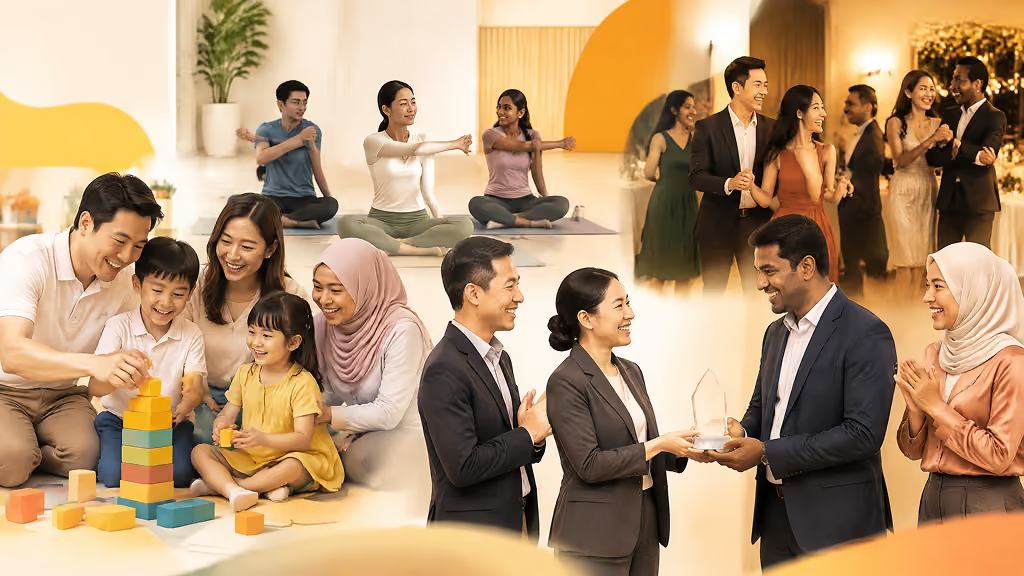
Employee engagement activities in Singapore are frequently planned one event at a time: a Family Day approved in April, a wellness talk slotted in when a vendor becomes available, a Dinner & Dance scrambled together when year end approaches. Each event may succeed on its own, yet the overall engagement effort feels disjointed, and the gaps between events are where momentum quietly drains.
This is rarely a question of commitment. HR and people teams carry recruitment, payroll cycles, appraisals and compliance alongside engagement, so a structured engagement calendar may take a backseat. The fix is to plan the year once, anchor each quarter on a flagship moment, and let an always-on layer, such as a customised employee portal, sustain recognition between events.
This guide sets out a quarter-by-quarter plan built for Singapore’s rhythm: school holidays for Family Days, the year-end peak for Dinner & Dance, and wellness initiatives that reach frontline, shift-based and desk-based employees alike.
Why Employee Engagement Activities in Singapore Need a Yearly Plan
An annual plan matters because engagement is built continuously, and single events cannot carry it alone. A calendar turns scattered activities into a programme that leadership can fund once and employees can see coming.
What the engagement data says
According to Gallup’s State of the Global Workplace 2026 report, based on 2025 data, only 14% of employees in Singapore are engaged at work, below the Southeast Asia average of 25% and the global average of 20%. The same report found that 43% of Singapore employees said they had experienced a lot of stress during the previous day, above the global average of 40%. Ad hoc, event-by-event engagement is not reaching enough of the workforce, evident in the statistics.
Events are amplifiers, not the engine
A Family Day or Dinner & Dance creates a shared memory that everyday work cannot, but it sits on top of everyday engagement efforts rather than replacing them. The engine is the always-on layer: peer recognition, wellness nudges, rewards and milestone acknowledgements running week after week. A customised employee portal gives HR one place to administer that layer across a large workforce, so the set-piece events amplify a rhythm that already exists.
The year at a glance
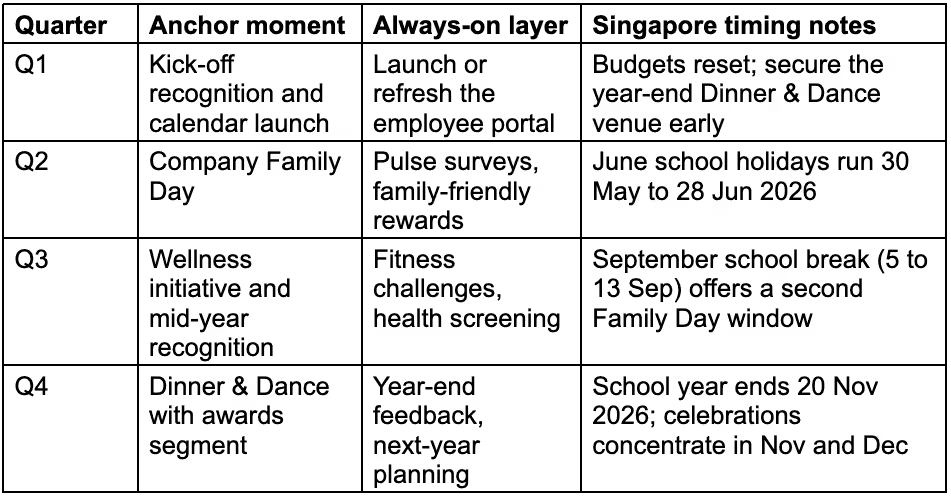
Q1 (January to March): Reset, Recognise and Lock In the Year
Q1 is the planning quarter: budgets are fresh, appraisal cycles conclude, and decisions made now determine how smoothly the rest of the year runs.
Open the year with recognition
Begin with a recognition moment that closes the previous year properly: a town hall segment naming specific team achievements, long-service milestones acknowledged in front of colleagues, and a leadership message that connects last year’s effort to this year’s goals. Recognition delivered early signals that the engagement calendar is a commitment, not an afterthought. It also starts the year on a high note, so employees head into the first quarter feeling motivated rather than simply back at their desks.
Launch the always-on layer
Q1 is the right time to stand up, or refresh, a customised employee portal so recognition, rewards and engagement administration run continuously from the first month. For workforces spanning frontline, shift-based and desk-based employees, the portal is what keeps engagement visible to people who will never be free for a 3pm weekday event. Publishing the full-year calendar through the same channel gives every employee notice of what is coming and when. Having something to look forward to matters in its own right, and a visible year of planned moments can contribute to long-term engagement and retention.
Book the year-end venue before Q1 closes
Dinner & Dance demand in Singapore concentrates in November and December, and large-format venues offer a limited number of peak dates. Securing your venue and date in Q1 gives the widest choice and removes the biggest single risk from the Q4 plan. This is also when to shortlist formats and request quotes, well before the busy season narrows your options.
Q2 (April to June): Family Day Season
Q2 belongs to the Family Day, timed so employees’ children can attend. The June school holidays run from 30 May to 28 June 2026, according to the Ministry of Education’s published calendar, which makes June the natural peak for family-inclusive engagement.
Time it to the June school holidays
A Family Day scheduled within the school break removes the main barrier to attendance for working parents. April and May then become the runway: confirm headcount bands, plan logistics for multiple sites, and open registration through the employee portal so take-up is tracked rather than guessed.
Choose a format that fits the whole workforce
For organisations in the 500 to 800 or 800 to 1,000+ range, venue choice decides whether the day feels like one celebration or several disconnected ones. Wild Wild Wet at Downtown East offers a water park Family Day that children remember, while D’Marquee, a 2,400 sqm pillarless, air-conditioned blank canvas in the same Downtown East ecosystem, suits carnival-style programmes with booths, stage segments and mass activities regardless of weather. The Begonia Ballroom and Cassia and Aster Rooms in the same precinct add indoor space for breakout activities or a quieter zone for older family members. Carnival and funfair elements, curated via our partner network, can be coordinated alongside the venue through a single point of contact.
Run staggered sessions for shift-based teams
A single-day event will always exclude employees rostered to work it. Planning two sessions, or a weekend date plus a smaller weekday session, brings frontline and shift-based employees into the same celebration rather than leaving them to see the photos afterwards. Building this into the Q2 plan from the start is far easier than retrofitting it once invitations are out.
Q3 (July to September): Wellness and Recognition Momentum
Q3 is where calendars most often go quiet, with the Family Day done and the Dinner & Dance still months away. Filling it with wellness and recognition keeps engagement continuous through the longest stretch of uninterrupted work in the year. It is also a sensible point to slot wellness in, since employees have been ramping up responsibilities through the first two quarters and the third is when that accumulated load starts to show.
Run a structured wellness initiative
Wellness belongs in the engagement calendar because supported employees have the capacity for discretionary effort, and because wellness activities reach shift and frontline employees in a way a single annual event cannot. A multi-week fitness or step challenge and workshops on sleep, nutrition or mental wellbeing, curated via our partner network, all fit naturally into employee engagement, recognition and wellness programming. The Health Promotion Board actively encourages structured workplace health programmes, which helps HR pair the employee benefit with an organisational one at sign-off.
Mark mid-year recognition moments
Recognition can occur any time. A mid-year spotlight on completed projects, service milestones reached since January, and peer-nominated contributions, administered through the employee portal, keeps appreciation specific and timely. The September school break, from 5 to 13 September 2026, also offers a second family-friendly window for organisations that could not gather everyone in June.
Start Dinner & Dance production work
With the venue secured since Q1, Q3 is when the production detail begins: theme selection, award categories and nominations, entertainment and emcees curated via our partner network, and catering decisions. Starting in Q3 spreads the workload across months instead of compressing it into a stressful October.
If you are mapping your own calendar against headcount and budget, request a package quote to test the plan against real options before Q4 planning locks in.
Q4 (October to December): The Year-End Celebration Peak
Q4 is Singapore’s celebration season, and the Dinner & Dance is its centrepiece. With the school year ending on 20 November 2026, late November and December are when most organisations gather the full workforce.
Stage the Dinner & Dance
A well-run D&D closes the year with the entire organisation in one room, something no digital channel replicates. D’Marquee’s pillarless hall at Downtown East stages large-scale dinners without the CBD or Marina Bay venue premium, with the Begonia Ballroom and Cassia and Aster Rooms in the same precinct for smaller cohorts. For organisations that prefer a classic ballroom setting, ballroom-style event spaces are available at those rooms and at Orchid Country Club in Yishun, which pairs them with extensive recreational facilities.
Put recognition on the stage
Build a structured awards segment into the evening: values-based awards, long-service recognition for five, ten and fifteen-year milestones, and team achievements named in front of colleagues. An award presented on stage in front of the whole organisation lands very differently from the same award announced by email.
Close the loop for next year
Before December ends, run a short feedback pulse through the employee portal covering the year’s events and always-on programmes. Participation data and feedback gathered now become the evidence base for next year’s calendar and budget conversation, turning engagement from an annual leap of faith into a measured programme.
Making Every Quarter Work for a Large Workforce
A calendar only works if it reaches the whole organisation, and that requires planning by engagement layer rather than by event alone.
Plan by engagement layer
A balanced year moves through four layers: departmental touchpoints such as appreciation lunches and local recognition, cross-department initiatives such as wellness challenges, company-wide milestones such as the Family Day and Dinner & Dance, and an always-on platform underneath all of them. If every activity in your draft calendar sits in the company-wide layer, the plan will feel like long silences punctuated by big events.
Schedule for a heterogeneous workforce
Large Singapore workforces mix frontline, shift-based and desk-based employees across different sites and rosters. Every quarter’s plan should answer the same question: how does this reach the employee who works Saturdays, or nights, or at a site with no event space? Staggered sessions, on-site delivery for wellness activities and portal-based recognition are the practical answers, and they need to be budgeted from the start.
Secure budget once, not four times
Presenting a full-year calendar with quarterly anchors, always-on programmes and expected reach is a stronger sign-off conversation than four separate event requests. It also lets finance see the engagement spend as one programme with one outcome, supported by the participation and feedback data the portal collects across the year.
FAQs on Employee Engagement Activities in Singapore
What are examples of employee engagement activities in Singapore?
Common formats include company Family Days timed to the school holidays, year-end Dinner & Dance celebrations with awards segments, wellness initiatives such as fitness challenges and health screenings, recognition programmes for service milestones, and creative workshops. Larger organisations typically pair these set-piece events with an always-on digital platform that carries recognition and rewards between them.
How often should employee engagement activities run?
A practical rhythm is one flagship moment per quarter, supported by continuous recognition and wellness programming in between. Quarterly anchors keep engagement visible across the year, while the always-on layer ensures employees who miss an event are not excluded from the programme entirely.
When should we book a year-end Dinner & Dance venue?
As early in the year as possible, ideally in the first quarter. Demand for November and December dates concentrates across many organisations at once, and large-format venues have a limited number of peak evenings, so early booking secures both the date and the widest choice of formats.
How do we engage frontline and shift-based employees who cannot attend office events?
Plan staggered or repeated sessions for major events, bring wellness activities on-site across locations, and run recognition through a digital portal that employees can access on any schedule. The goal is one engagement programme that reaches the entire workforce, rather than a calendar that only serves desk-based employees during weekday hours.
Planning the Year Ahead
A yearly plan turns employee engagement activities in Singapore from a series of isolated efforts into a programme: recognition and venue booking in Q1, a Family Day over the June holidays in Q2, wellness and mid-year recognition in Q3, and a Dinner & Dance that closes the year in Q4, with a customised employee portal sustaining engagement between every anchor. From employee recognition and wellness programmes to Family Days, Dinner & Dance celebrations and workforce engagement solutions, UPlay for Business helps organisations deliver meaningful experiences at scale while reducing administrative effort for HR teams. Request a package quote to build your calendar against real venues and formats, or see how other companies did it in our case studies.