

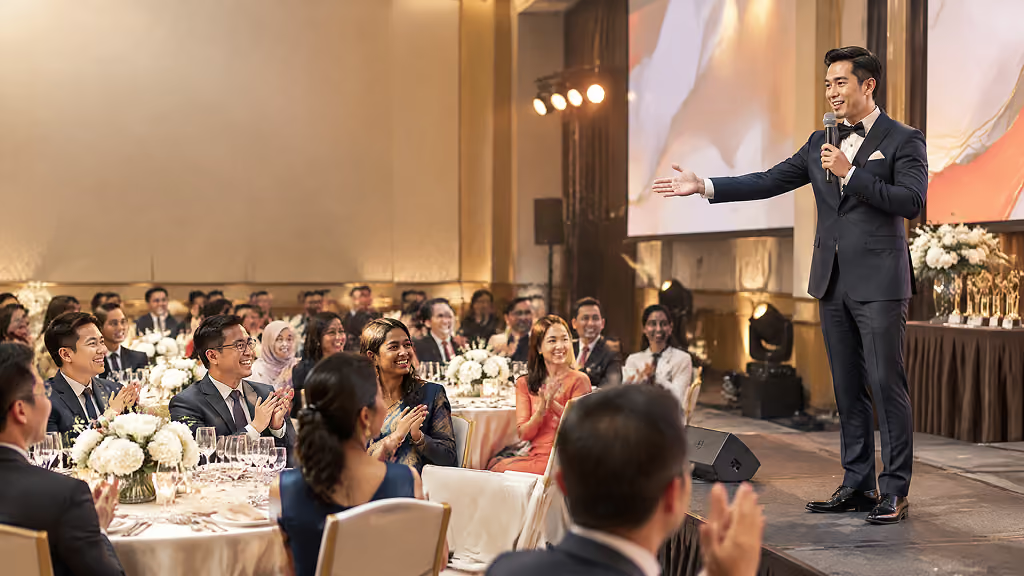
The emcee is the only vendor your guests experience continuously, from the welcome address to the final lucky draw. The venue, catering and entertainment each carry part of the evening, but the host carries all of it, which is why choosing a dinner and dance emcee in Singapore deserves the same rigour HR teams apply to the venue shortlist. The stakes rise with headcount: at 500, 800 or 1,000 guests and above, a host who cannot command a large ballroom, switch languages for a multicultural workforce or keep an awards segment moving will be felt at every table.
This guide sets out what a professional emcee actually does at a large-scale Dinner & Dance, the specific capabilities to look for, the factors that drive emcee pricing in Singapore, how briefing and rehearsals should work, and the red flags that should stop a booking. It also explains how UPlay for Business curates emcees through its partner network, so HR teams coordinate the emcee, entertainment and venue through a single point of contact rather than three separate vendors.
What a Dinner and Dance Emcee Does at a Large-Scale Event
A Dinner & Dance emcee manages the energy, timing and flow of the entire evening: opening the event, bridging segments, hosting awards and games, and recovering gracefully when the programme runs off schedule. At a large-scale Dinner & Dance, that role expands from entertainer to programme controller.
Programme control and timekeeping
A typical corporate D&D packs a welcome address, leadership speeches, dinner service, performances, awards, games and a lucky draw into roughly four hours. The emcee is the person who protects that run sheet in real time: tightening a segment when dinner service overruns, filling gracefully while AV resets, and cueing speakers so senior leaders are never left waiting at the stage steps.
Energy management across a large ballroom
An audience of 500 to 800 guests behaves differently from a boardroom function. Tables at the back of a large hall are far from the stage, sight lines depend on screens, and energy dissipates quickly across a big floor. An experienced host works the room deliberately, moving off-stage for interactive segments, using table call-outs so distant guests stay involved, and pacing high-energy moments so the evening builds rather than peaks at 8pm.
Awards and recognition segments
For many organisations the awards segment is the point of the evening, recognising long service and outstanding performance in front of the whole company. A capable emcee rehearses name pronunciations, reads citations with genuine warmth, paces trophy handovers and photo moments so momentum holds, and gives frontline and shift-based award recipients the same stage presence as senior management. Handled poorly, this segment drags; handled well, it becomes the moment employees remember.
What to Look For When Hiring a D&D Emcee in Singapore
The strongest indicator of a good hire is proven experience hosting corporate events at your scale, supported by bilingual capability where your workforce needs it. Three capabilities matter most for large workforces.
Bilingual or multilingual hosting
Singapore’s large workforces are multicultural by default, spanning English, Mandarin, Malay and Tamil speakers across frontline, shift-based and desk-based roles. Review your actual audience composition before deciding: a workforce concentrated in operations and production roles may engage far better with a host who moves comfortably between English and Mandarin, or who can deliver key moments in Malay. Ask shortlisted emcees for footage of genuine code-switching in front of an audience, not just a stated language list on a profile.
Stage presence at scale
Hosting 1,000 guests in a pillarless hall is a different craft from hosting an intimate private function. Look for evidence that the emcee has worked rooms comparable to yours: comfort on a raised stage with IMAG screens, a voice and physicality that project to the back tables, and interactive formats designed for mass participation rather than small-group banter. Ask directly for the largest audience the emcee has hosted and request footage from that event.
Corporate track record and audience judgement
A D&D host must balance formality and fun in front of senior leadership, union representatives and guests of honour. Review demo reels for corporate settings specifically, and check that the emcee handles VIP protocol, speech introductions and sensitive moments with care. References from organisations of a similar size and profile to yours are worth more than a long list of unrelated gigs.
What Drives Emcee Rates in Singapore
Emcee pricing in Singapore varies widely, and no single figure applies across the market: the final fee depends on who is booked, for how long, and at what time of year. Published guides give a useful baseline: the Singapore Emcee Portal places typical Dinner & Dance emcee fees between S$1,000 and S$3,000, while noting that reputation, event type, duration and seasonal demand all move the figure.
The factors behind the quote
Across the market, five factors do most of the work in setting an emcee’s fee:
- Experience and reputation. Established corporate hosts with a strong track record command more than emerging talent, and celebrity hosts sit in a different bracket altogether.
- Bilingual or multilingual delivery. Hosting fluently across languages is a specialist skill, and emcees who offer it may price above single-language delivery.
- Event scale and complexity. A 1,000-guest programme with awards, performances and games demands more preparation than a compact function, and quotes tend to reflect that.
- Rehearsal and preparation time. Fees that include a full briefing, script development and an on-site rehearsal are typically higher than turn-up-and-host rates, and usually worth it.
- Peak season demand. The Singapore Emcee Portal notes that year-end Dinner & Dance season, Chinese New Year and the mid-year holidays are peak periods, when strong emcees are booked out early and pricing firms up.
Budget for the outcome, not the line item
Treat these figures as market context rather than a menu, since the right host for a 500 to 800 pax event and the right host for an 800 to 1,000+ pax gala are different hires at different price points. Rather than benchmarking the emcee fee in isolation, brief your requirements (headcount, languages, awards load, programme length) and evaluate quotes against them. If you would rather not run that sourcing exercise across multiple agencies yourself, request a package quote and UPlay for Business will scope the emcee alongside your venue and entertainment in one proposal.
Briefing, Rehearsals and AV Coordination
A strong emcee is only as good as the brief behind them, so treat briefing and rehearsal as part of the engagement, not an optional extra. For large-scale events, expect at least one structured briefing and an on-site technical run-through.
What the emcee brief should contain
Give your emcee the full run sheet with timings, the theme and dress code, an approved pronunciation list for award recipients and VIPs, award citations, the profile of your workforce (departments, sites, language mix), and any topics to avoid. Include context that helps the host sound like part of the company for one evening: recent milestones, in-jokes that travel well, and the names the CEO should be introduced with.
Rehearsal expectations at scale
For 500 guests and above, a script read-through alone is not enough. A professional emcee should walk the actual stage, test microphones and foldback, rehearse award sequences with the AV operator, and agree visual cues for stretching or cutting segments. Confirm upfront whether rehearsal attendance is included in the fee, since this is a common source of quote differences.
Coordinating emcee, AV and entertainment
On the night, the emcee, AV crew, band or DJ, performers and caterer must move as one unit, and misalignment between them is the most common cause of dead air. Someone has to own that coordination: consolidated cue sheets, a single communication channel during the event, and clear handover points between segments. This is where a coordinated planning model earns its keep, with one producer aligning every vendor against the same run sheet instead of the HR team relaying messages between them.
Tip: Schedule the emcee’s technical rehearsal for the afternoon of the event itself, after the AV set-up is complete. Rehearsing on a half-built stage produces a false sense of readiness.
Red Flags to Watch Before You Confirm
Most emcee disappointments are visible before the contract is signed. Three warning signs deserve particular attention for a large-workforce D&D.
Lack of footage or references at your scale
An emcee without videos of themselves hosting a comparable corporate audience is akin to you banking solely on faith. Polished showreel edits are not the same as an unbroken segment in front of a real crowd, so ask for both, plus a reference from an organisation of similar size.
No structured briefing or rehearsal process
A professional host will ask you detailed questions about the programme, audience and awards before quoting. An emcee who is happy to “just turn up on the night”, or who resists attending a technical rehearsal for a 500-guest event, is signalling how much preparation your evening will actually get.
Vague terms on timing, overtime and backup
The quote should state the hosting duration, overtime charges, rehearsal inclusions and what happens if the emcee falls ill. Year-end season is unforgiving: strong hosts are fully booked, so a vendor with no stated backup arrangement leaves your flagship event exposed. Working through a curated network with access to multiple vetted hosts materially reduces this risk.
How UPlay for Business Sources Your Emcee
Emcees are curated via UPlay for Business’s partner network of vetted hosts and entertainment vendors across Singapore, then matched to your event’s scale, language mix and programme. That model exists because the right host depends on the audience, and a network offers a far wider match than any fixed roster.
Matched to a large-workforce audience
UPlay for Business specialises in large workforces, with group sizes running from 500 to 800 pax and up to 800 to 1,000+. Emcee curation reflects that: hosts are shortlisted for proven large-audience delivery and for the bilingual range a heterogeneous workforce of frontline, shift-based and desk-based employees actually needs, so the evening lands with every table and not only the HQ crowd.
One point of contact across emcee, entertainment and venue
Instead of separately contracting an emcee, a band, an AV crew and a ballroom, HR teams work with one UPlay for Business contact who coordinates all of them against a single run sheet. Fulfilment can run through owned venues, including D’Marquee at Downtown East, a 2,400 sqm pillarless, air-conditioned blank canvas suited to large-format D&Ds, the Begonia Ballroom and Cassia and Aster Rooms in the same precinct, and Orchid Country Club in Yishun, with ballroom-style evenings possible at either location, or through partner venues island-wide. Because the same team briefs the emcee, the entertainment and the venue crew, cues align and the programme holds together on the night.
FAQs on Hiring a Dinner and Dance Emcee in Singapore
How much does a dinner and dance emcee cost in Singapore?
Published industry guides, including the Singapore Emcee Portal, place typical D&D emcee fees between S$1,000 and S$3,000, with celebrity and senior hosts above that range. The final quote depends on experience, languages, event scale, rehearsal inclusions and how close your date sits to peak year-end season, so brief your requirements and compare quotes against them.
Do we need a bilingual emcee for our company D&D?
Base the decision on your actual workforce composition rather than a default assumption. Organisations with large frontline or operations populations often benefit from English-Mandarin hosting, with key moments in Malay or Tamil where relevant, while a predominantly English-comfortable audience may be better served by the strongest available single-language host.
How far in advance should we book an emcee for a year-end D&D?
Confirm the emcee as soon as your date and venue are locked in, ideally months ahead for dates in the October to January window. Industry guides consistently identify year-end D&D season as a peak period, and the emcees with the strongest large-audience track records are the first to be fully booked.
Can the emcee run our awards and lucky draw segments?
Yes, and this is where an experienced corporate host adds the most visible value. Expect the emcee to rehearse recipient names, read citations, pace trophy presentations and photo moments, and keep lucky draw mechanics transparent and quick, in coordination with your AV crew and organising committee.
How does UPlay for Business source emcees?
Emcees are curated via UPlay for Business’s partner network of vetted professional hosts and matched to your event’s headcount, language needs and programme. One UPlay for Business point of contact then coordinates the emcee together with your entertainment, AV and venue, so HR teams manage a single relationship rather than several vendors.
Booking the Right Voice for Your D&D
The emcee decision shapes how 500 or more employees remember the biggest night on your engagement calendar, so it deserves evidence, briefing time and a clear contract rather than a late add-on booking. Shortlist for large-audience experience and the right language mix, insist on a structured brief and technical rehearsal, and treat published rates as context for evaluating quotes rather than a target price. From employee recognition and wellness programmes to Family Days, Dinner & Dance celebrations and workforce engagement solutions, UPlay for Business helps organisations deliver meaningful experiences at scale while reducing administrative effort for HR teams. Request a Package Quote to have an emcee scoped alongside your venue and entertainment, or see how other companies did it in our case studies.