
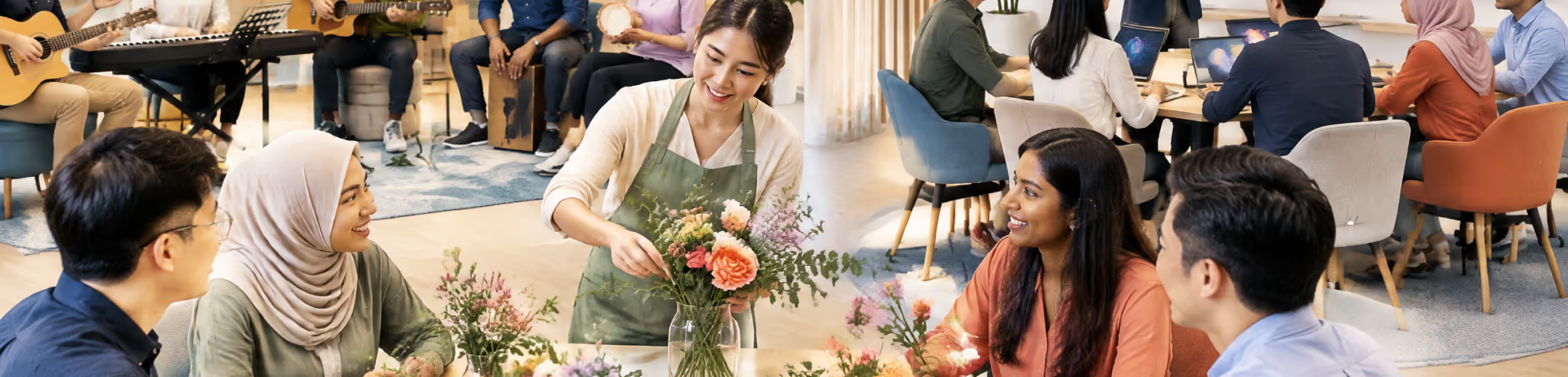
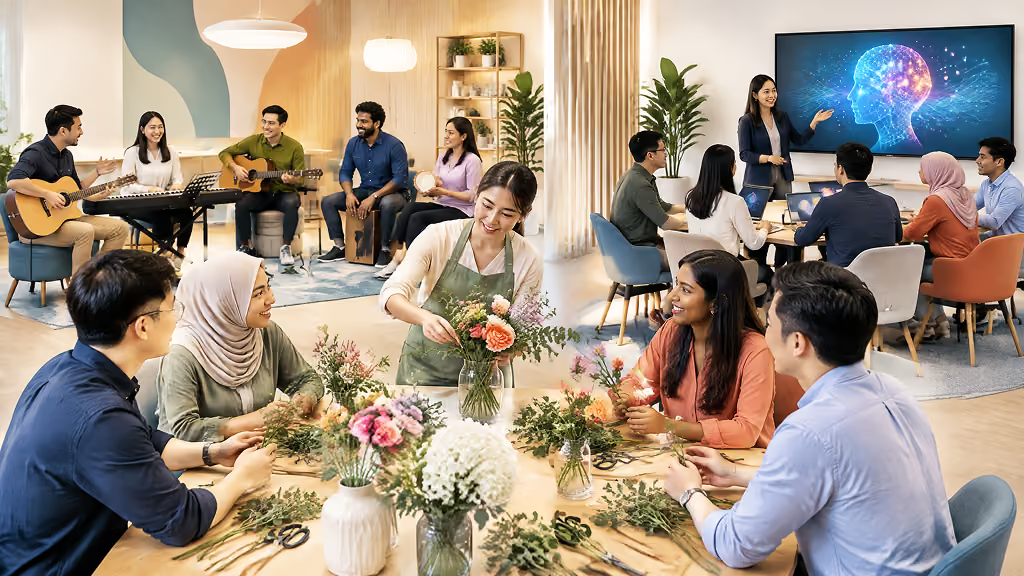
Most engagement calendars lean heavily on food. A catered lunch is easy to approve, easy to organise but forgotten by Friday. Creative workshops for employees offer a different return on the same engagement budget: participants learn a skill, get hands on and leave with an object that keeps the gesture visible long after the plates are cleared.
For HR and people teams responsible for large workforces, practicality matters. Which formats serve an appreciation programme, which focus on wellbeing, and which genuinely connect departments? How do sessions reach shift and frontline employees who cannot attend a 3pm weekday activity? And how is impact measured beyond a satisfaction survey?
This guide answers those questions through a programme lens. It maps workshop categories to engagement, wellbeing and appreciation goals, sets out delivery models for heterogeneous workforces, and shows how a customised employee portal turns one-off sessions into a year-round rhythm. Throughout, the focus is corporate delivery at scale, not individual hobby classes.
Why Creative Workshops Earn a Place in the Engagement Calendar
A creative workshop justifies its slot in the engagement calendar because it delivers three things a routine perk does not: novelty, a sense of mastery and a tangible result. Those qualities are worth taking seriously, because Gallup's State of the Global Workplace found that only 20% of employees worldwide were engaged at work in 2025, and only 34% were thriving in their overall wellbeing. Routine gestures alone are not closing that gap.
Novelty, mastery and a keepsake that outlasts the event
Most employees have attended many catered lunches and very few pottery sessions, so a workshop registers as a considered gesture rather than a calendar default. Learning a new skill in a single sitting also gives participants a small, complete sense of accomplishment, which sits comfortably with Singapore's broader culture of lifelong learning under SkillsFuture. The finished candle, terrarium or canvas then goes home or onto a desk, where it quietly extends the life of the gesture in a way no buffet can.
Inclusion for employees who do not drink or play sport
Drinks evenings exclude employees who do not drink, and sports formats exclude those who cannot or prefer not to play. Creative workshops have a lower barrier: no fitness requirement, no alcohol, no prior skill, and formats that suit quieter personalities as well as outgoing ones. For a large workforce, that inclusiveness should be a necessity instead of a luxury. It matters all the more in a multiracial, multicultural setting like Singapore, where dietary rules, religious practice and social preference vary widely across one employee list, and a format that sidesteps all of them is genuinely open to everyone.
A signal of appreciation, not just an activity
Because a workshop involves curation, materials and a facilitator, employees may read it as evidence that the organisation invested thought, not just budget. That perception is precisely what appreciation programmes are trying to create, and it is difficult to buy with vouchers alone.
Appreciation: Gift-Making Workshops That Say Thank You
For appreciation programmes, the strongest formats are ones where employees make something worth keeping or giving. The object itself becomes the thank-you.
Candle-making sessions
Scented candle workshops are a reliable appreciation format: sessions are compact, the process is easy for complete beginners, and everyone leaves with a finished product. When hosted as a departmental appreciation gesture after a demanding quarter, the intent is perceived as personal rather than procedural. Sessions of this kind are curated via our partner network of studios and facilitators, so HR teams do not need to source or vet vendors themselves.
Perfume and fragrance-blending workshops
Fragrance blending adds an element of personalisation that suits milestone appreciation, such as long-service cohorts or award recipients. Each participant composes a scent to their own preference, which makes the takeaway feel individual even when hundreds of employees take part across multiple runs.
Pairing gift-making with recognition moments
Gift-making workshops work hardest when they are tied to a recognition moment rather than scheduled in isolation. A session held in the week of a company anniversary, or offered to teams named in quarterly awards, connects the object to the reason for it. The made-by-hand element also gives leaders something specific to reference when they say thank you.
Wellbeing: Calm-Focus Formats That Give Employees Room to Breathe
Wellbeing, and mental wellbeing in particular, has become a far more prominent topic in Singapore workplaces than it was a few years ago. For wellbeing programmes, the best creative formats are slow, tactile and screen-free, giving employees a legitimate pause in the working week. Wellbeing belongs in the engagement remit for a practical reason: supported employees have more capacity for discretionary effort, and wellbeing activities can reach shift and frontline employees whom a single annual event never will.
Terrarium building
Terrarium workshops combine light horticulture with quiet, focused assembly work, and the result is a low-maintenance living arrangement that survives on an office desk. The format scales well across repeated small sessions, which suits rolling wellbeing calendars better than one large gathering.
Pottery and clay work
Clay formats ask for sustained attention with the hands, which is exactly why many participants describe them as absorbing and restful. Organisations exploring workplace mental health support may find these sessions a gentler entry point than seminar-style programmes, because the wellbeing benefit comes from the activity rather than a lecture.
Making calm formats part of the wellness calendar
A single terrarium afternoon is a gesture; a quarterly rhythm of calm-focus sessions is a programme. Slotting these formats into a broader employee engagement, recognition and wellness calendar, alongside health and recognition initiatives, keeps wellbeing visible between the big set-piece events rather than concentrated in one month of the year. In a fast-paced, always-moving working culture like Singapore's, formats that give employees a legitimate reason to slow down for an hour are worth protecting in the calendar rather than dropping at the first scheduling clash.
Engagement: Creative Sessions That Connect Departments
For engagement goals, the most effective creative workshops are collaborative by design, putting employees from different departments around the same table with a shared task. This is the cross-department layer of an engagement programme: wider than a departmental gesture, smaller than a company-wide milestone event.
Art jamming at scale
Art jamming, where participants paint individual canvases in a shared, social setting, is one of the most flexible large-group creative formats. Because the activity is self-paced, conversation flows naturally, and mixed seating quietly does the work of introducing colleagues who would otherwise never meet.
Collaborative murals and large-format pieces
A step up in ambition is a collective piece: individual painted tiles or canvas segments that assemble into one large mural. The finished artwork can be hung in a lobby or canteen as a permanent, visible record that the whole organisation made something together, reinforcing unity and giving the session a legacy beyond the afternoon itself.
Designing the mix deliberately
Cross-department value does not happen by accident. Assign seating or teams across functions, brief facilitators to rotate groups, and schedule multiple runs so that desk-based and frontline employees are mixed rather than segregated by convenience. The design of the room matters as much as the choice of activity.
Delivering Workshops Across a Large Workforce
For large workforces, delivery tends to matter at least as much as format selection. A single session cannot reach a workforce spread across sites, shifts and job types, so the delivery model has to do the reaching.
Departmental rollouts
Rather than one oversubscribed company event, run the same workshop as a series of departmental sessions over several weeks. Each group gets a right-sized experience, managers can schedule around operational demands, and the programme accumulates reach week by week. A coordinated approach helps here: one point of contact manages the studios, materials and scheduling across every run, curated via our partner network.
Staggered sessions for shift and frontline employees
Shift-based and frontline employees are the first to be excluded when activities default to weekday office hours. Staggered sessions across mornings, afternoons and post-shift slots, repeated across rosters, are the difference between an office perk and a genuinely company-wide experience. Planning for this from the start costs little; retrofitting it after complaints costs credibility.
On-site and venue-based delivery
Bringing facilitators to a workplace removes travel friction for operational teams, while an off-site run gives desk-based employees a change of scene. For large-scale creative sessions tied to a milestone moment, a venue such as D'Marquee at Downtown East offers a 2,400 sqm pillarless, air-conditioned blank canvas that can hold an entire organisation's session under one roof. Many programmes blend both models.
If you are weighing formats and delivery models against your own calendar, see how other companies did it or request a package quote to talk through options for your workforce.
Measuring Impact and Building a Year-Round Programme
A workshop programme earns continued budget when it can show reach and follow-through. Three measures matter most.
Track participation across employee segments
Headline attendance hides absentees. Break participation down by department, site and shift pattern, and treat uptake among frontline and shift-based employees as the key health indicator of the programme. If only desk-based teams are attending, the delivery model, not the format, needs adjusting.
Tie workshops into recognition
Workshops multiply their value when they connect to recognition: sessions offered to award-winning teams, gift-making runs timed to service milestones, or workshop places used as recognition rewards in their own right. Linking the two programmes gives each workshop a reason employees can name, and gives the recognition programme experiences worth wanting.
Carry momentum through a customised employee portal
Between sessions, a customised employee portal gives HR one place to publish upcoming workshop runs, manage sign-ups across sites and shifts, issue recognition and rewards, and monitor participation data across the workforce. For organisations of this scale, that always-on layer transforms scattered activities into a programme, removing most of the administrative load from the HR team.
Note: Events amplify engagement; they do not substitute for it. A memorable workshop sits on top of everyday engagement efforts, and the calendar should treat it as a peak in an ongoing rhythm rather than the rhythm itself.
FAQs on Creative Workshops for Employees
What are creative workshops for employees?
Creative workshops for employees are facilitated hands-on sessions, such as candle-making, terrarium building, pottery or art jamming, organised by an employer as part of its engagement, wellbeing or appreciation programme. Participants learn a skill and usually take home a finished piece.
How do creative workshops support employee engagement?
They provide novelty, a sense of accomplishment and shared experiences across departments, all of which contribute to a stronger sense of connection at work. They are one input among many: engagement still depends on everyday factors such as management, workload and recognition.
How can creative workshops reach shift and frontline employees?
Run repeated, staggered sessions across rosters rather than one fixed-time event, and use on-site delivery so operational teams do not need to travel. Publishing schedules and sign-ups through an employee portal helps every segment see and book sessions that fit their shifts.
How often should organisations run creative workshops?
There is no fixed rule, but many organisations find a quarterly rhythm sustainable: enough frequency to keep the programme visible, with time between runs to rotate formats and reach different departments. The key is a planned calendar rather than ad hoc bookings.
How do we measure whether a workshop programme is working?
Track participation across departments, sites and shift patterns, gather short post-session feedback, and watch whether uptake broadens over time. Pair those signals with recognition tie-ins and portal activity data to show the programme is reaching the whole workforce, not just one office.
From One-Off Session to Engagement Rhythm
Creative workshops deserve a place in the engagement calendar because they do what a catered lunch cannot: signal genuine appreciation, give employees a restorative pause and connect departments through a shared, hands-on experience. The organisations that get the most from them choose formats by programme goal, plan delivery around shifts and sites from the outset, and measure reach across every employee segment. From employee recognition and wellness programmes to Family Days, Dinner & Dance celebrations and workforce engagement solutions, UPlay for Business helps organisations deliver meaningful experiences at scale while reducing administrative effort for HR teams. Request a package quote to plan a workshop programme for your workforce, or see how other companies did it in our case studies.