
Booking a corporate workshop in Singapore for a small group is a quick job. Booking creative experiences for a workforce of several hundred employees, spread across departments, shifts and sites, is a planning exercise of a different order. Most workshop listings are written for small-group bookings, so HR teams in larger workforces are left to work out which formats scale, how to schedule them fairly, and how many vendors they will need to coordinate.
This guide takes a menu approach instead. It sets out the main creative workshop categories available in Singapore, art-based, craft-based, and scent-and-flavour, then covers how to choose between them by objective, how to deliver them across a large workforce, what actually drives cost, and how to turn a one-off session into a lasting engagement outcome, including follow-through via a customised employee portal. Every format here can be curated through UPlay for Business’s partner network and booked as a corporate or group programme through a single point of contact.
Art-Based Workshops: Painting and Pottery
Art-based workshops give employees a guided creative outlet with no prior skill required, which makes them one of the most inclusive formats on the corporate workshop menu. Because the activity is individual but the setting is shared, they work equally well for desk-based teams and frontline groups meeting outside their usual roster.
Art jamming
Art jamming sessions give each participant a canvas, paints and light facilitation, either freeform or built around a shared theme such as company values or a milestone year. The format is popular with Singapore employers because it needs no experience, runs comfortably in large rooms, and produces finished pieces that can be displayed back in the office as a visible record of the day. Sessions can be run as individual canvases or as a collaborative mural assembled from many smaller panels, a format that suits company-wide milestones.
Pottery and clay work
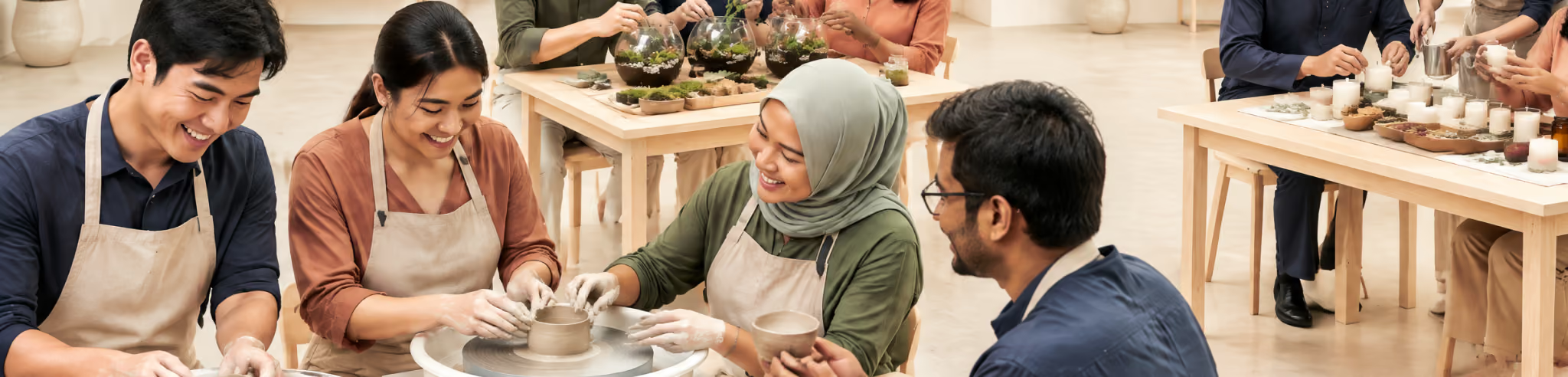
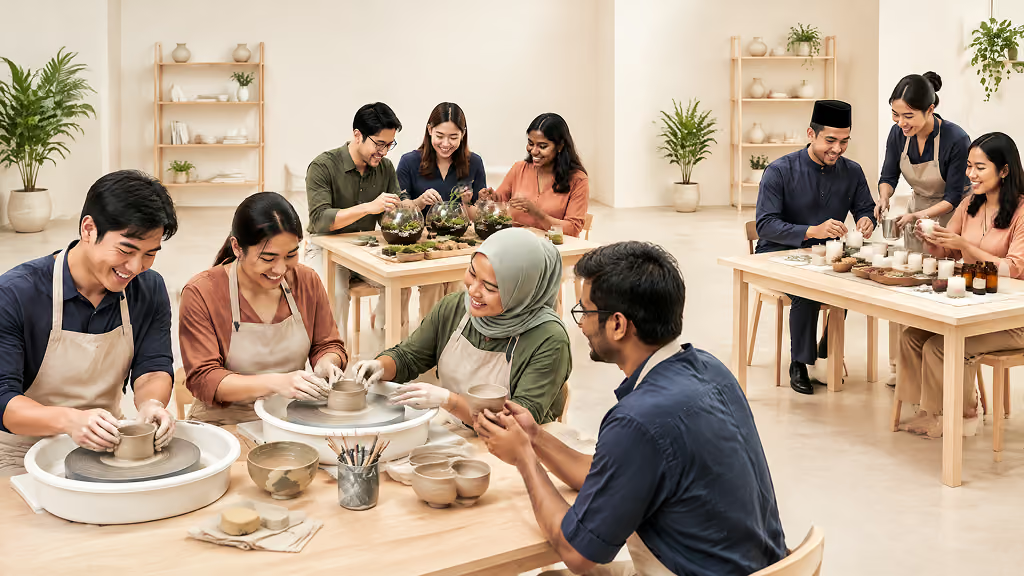
Pottery workshops introduce employees to hand-building or wheel-throwing techniques, producing functional pieces such as bowls, cups and trinket dishes. The slower, tactile pace makes this one of the calmest formats on the menu. Pottery does require specialist studios, kilns and lower participant-to-instructor ratios, so partner studios typically deliver it in smaller batches. For a large workforce that usually means a rolling series of departmental sessions rather than a single mass event.
Craft-Based Workshops: Leather, Terrariums and Tote Bags
Craft-based workshops centre on making a physical keepsake, and that take-home object is the point: it keeps the experience visible on a desk or in daily use long after the session ends. These formats are compact, need little specialist infrastructure, and are among the easiest to run on-site at your own premises.
Leather crafting
Non-stitched leather workshops guide employees through cutting, embossing and assembling small goods such as cardholders, key fobs and passport sleeves. The materials feel premium, which makes this format a natural fit for recognition programmes and long-service cohorts, where the gesture should feel considered rather than mass-produced. Personalised embossing, such as initials or a milestone year, strengthens recognition further.
Terrarium building
Terrarium workshops have employees assemble a miniature landscape of plants, soil layers and decorative elements in glass. The format is frequently chosen for wellness-adjacent programming: the activity is quiet and absorbing, and the finished terrarium becomes a small piece of greenery employees keep at their workstations. It is also one of the most logistics-friendly formats for large groups, since materials pack down into simple per-person kits.
Tote bag painting
Tote bag painting is one of the most scalable craft formats available: low-cost materials, no specialist equipment, and a finished product employees actually use. For organisations planning a company-wide rollout, painted totes double as practical keepsakes, and a themed design brief, such as sustainability or a company anniversary, gives the session a shared purpose without constraining individual creativity.
Scent and Flavour Workshops: Candles, Perfume, Coffee and Cooking
Scent-and-flavour workshops trade brushes and leather tools for wax, fragrance oils, coffee beans and ingredients, and they tend to feel more like a curated lifestyle experience than a craft class. They are strong choices when the goal is appreciation: the formats feel generous, and several produce items suited to festive gifting. Activities that engage the senses also tend to be remembered for longer, because a scent or a taste attaches itself to the occasion in a way a slide deck never does, and employees are reminded of the day every time they light the candle or brew the coffee.
Candle making
Soy candle workshops walk employees through scent profiles, wicking and pouring, with each participant taking home a finished candle. Because the output is giftable and the session slots neatly into the final quarter, candle making is a popular pick in the lead-up to year-end celebrations and pairs naturally with the festive season around a company’s Dinner & Dance.
Perfume blending
Perfume workshops let each employee compose a personal fragrance from a library of base, middle and top notes, guided by a trained facilitator. The format feels distinctly premium and individual, which suits appreciation programmes for milestone cohorts or leadership groups, and the bottled result is a keepsake employees associate with the organisation that arranged it.
Coffee appreciation and cooking
Coffee appreciation sessions cover tasting, brewing methods and latte art, while cooking workshops take groups through a menu from preparation to shared meal. Both teach skills employees reuse in daily life, which extends the value of the session well beyond the day itself. Cooking in particular requires equipped kitchen studios and tighter per-session capacity, so for large workforces it is usually delivered as a repeated series through partner venues.
Choosing a Corporate Workshop by Objective
The fastest way to shortlist a corporate workshop is to start from the HR objective, not the activity. Each category on the menu serves some goals better than others, and matching format to intent is what separates a memorable programme from a generic one.
Appreciation and recognition
When the objective is appreciation, choose formats with a premium feel and a lasting keepsake: leather crafting, perfume blending or candle making. These work well as recognition tie-ins, for example, as a dedicated experience for long-service employees or a top-performing division, and they sit naturally inside a broader employee engagement, recognition and wellness programme rather than as a standalone gesture.
Wellness-adjacent calm
When the objective is to give employees genuine breathing room, favour quiet, absorbing formats: terrarium building, pottery and freeform art jamming. Organisations may find these sessions offer a rare stretch of screen-free focus in the working week, which is why they are often scheduled as part of wellness programming for teams coming off demanding periods. Reaching shift-based and frontline employees with this kind of calm matters as much as reaching head office.
Cross-department mixing and festive gifting
When the objective is connection across silos, choose sociable, low-barrier formats, such as art jamming, tote bag painting or cooking, and seat people deliberately across departments. When the objective is festive, lean on candle making and other giftable formats timed for the year-end season, so the workshop output becomes part of the company’s festive gifting rather than an extra line to procure.
Delivering Workshops Across a Large Workforce
A creative workshop only becomes a company-wide experience when the delivery model is designed for the size and shape of the workforce. Formats that run beautifully for a small group need deliberate structuring once the audience spans hundreds of employees on different schedules and sites.
Departmental rollouts
The simplest scaling model is a rolling series: the same workshop delivered department by department over several weeks. Each session stays within comfortable facilitator ratios, scheduling flexes around operational demands, and every department gets the same experience rather than a diluted version of it. This model suits studio-bound formats such as pottery and cooking, where per-session capacity is naturally tighter.
Staggered sessions for shift workers
Workforces with frontline and shift-based employees need session times that respect rosters, which usually means repeating the same workshop across morning, afternoon and post-shift slots or bringing facilitators on-site to operational locations. Planning this way ensures engagement reaches the employees a single 3pm weekday session would always miss, which is precisely the population large-workforce engagement is meant to include.
Multi-station scaling for company-wide events
For a single large gathering, workshops scale through parallel stations: multiple facilitated zones running simultaneously in one venue, with employees rotating or choosing their format. This is how creative experiences are delivered at the 500 to 800 pax level, and with enough stations and floor space the model extends to 800 to 1,000+ pax events. Coordinating the studios, facilitators and materials behind that is exactly what a curated partner network exists to do, under one point of contact instead of a dozen vendor threads.
Budgeting for Corporate Workshops in Singapore
Corporate workshop pricing in Singapore varies widely because quotes are built from several moving parts, not a single per-head rate. Understanding the cost drivers puts HR in a stronger position to shape the programme before asking for numbers.
The four main cost drivers
Four factors do most of the work in any workshop quote. Group size determines how many facilitators and sessions are needed, and larger bookings change the economics per participant. Materials vary sharply by format: leather and perfume components cost more than paint and canvas. Facilitation depends on the participant-to-instructor ratio the format safely allows. Venue depends on whether the workshop runs at your premises, at a partner studio, or within a larger event space alongside other programming.
Getting an accurate quote
Because these drivers interact, the practical route is to fix your headcount, objective and preferred delivery model first, then request a consolidated quote rather than pricing each vendor separately. UPlay for Business builds workshop programmes from its curated partner network and quotes them as one package. Request a Package Quote with your workforce size and timeline, or see how other companies did it before you scope your own programme.
Tip: Lead times grow with scale. A single-team session can be arranged at relatively short notice, but multi-session rollouts and year-end dates are best secured months ahead, before the festive booking crunch.
Turning Workshops into Lasting HR Outcomes
A workshop earns its budget when the experience feeds a longer engagement arc, not when it ends at the door. Engagement is a year-round effort, and creative experiences work best as amplifiers on top of everyday engagement rather than as substitutes for it.
Recognition tie-ins
The keepsakes workshops produce are ready-made recognition assets. Display a collaborative art jamming mural in the office, present leather goods embossed for long-service employees at an awards moment, or fold workshop vouchers into recognition programmes as an experience-based reward. Each tie-in extends the life of the session and connects it visibly to the behaviours the organisation wants to celebrate.
Follow-through with a customised employee portal
The gap between one-off events is where engagement usually stalls, and closing it is an administration problem as much as a creative one. UPlay for Business’s customised employee portal gives HR one place to run recognition, rewards and ongoing engagement across a large workforce between set-piece experiences, so a successful workshop series becomes part of a steady rhythm rather than an isolated highlight. For heterogeneous workforces, the portal is also how engagement reaches employees whose schedules kept them from any single session.
FAQs on Corporate Workshops in Singapore
What is a corporate workshop?
A corporate workshop is a facilitated group experience booked by an organisation for its employees, usually built around a creative skill such as art jamming, pottery, leather crafting, candle making or cooking. Unlike formal training, the primary goals are engagement, appreciation and shared experience, often with a physical keepsake each participant takes home.
How much does a corporate workshop cost in Singapore?
Pricing depends on group size, materials, facilitation ratios and venue, so quotes vary widely between formats and delivery models. Premium-material formats such as leather and perfume typically cost more per head than paint-based sessions. The most reliable approach is to fix your headcount and objective, then request a consolidated package quote.
Can corporate workshops be held in our own office?
Yes, many formats, including terrarium building, tote bag painting, candle making and art jamming, can be delivered on-site if you have a suitably sized function room, with facilitators bringing all materials. Studio-bound formats such as pottery and cooking generally run at partner venues with the required equipment.
How far in advance should we book a corporate workshop?
Lead times scale with the size and complexity of the programme. A single departmental session needs only modest notice, while multi-session rollouts, premium formats and year-end dates should be secured well in advance, since the festive quarter is peak season for corporate events across Singapore.
Are creative workshops suitable for senior leadership as well as frontline employees?
Yes, the same menu serves both audiences with different framing. Leadership groups tend to suit premium, compact formats such as perfume blending or coffee appreciation, while large mixed cohorts do well with scalable formats such as art jamming and tote bag painting delivered through staggered or multi-station models.
Building Your Workshop Menu with One Point of Contact
Creative corporate workshops give HR a flexible, repeatable way to reach an entire workforce, including older employees, for whom these formats are especially well suited: the sessions are seated and undemanding physically, while still being mentally stimulating and sociable. The menu spans art-based formats for inclusive participation, crafts for lasting keepsakes, and scent-and-flavour experiences for appreciation and festive gifting. The categories matter less than the match: choose by objective, design the delivery model around your shifts and sites, and let the cost drivers shape the quote conversation. From employee recognition and wellness programmes to Family Days, Dinner & Dance celebrations and workforce engagement solutions, UPlay for Business helps organisations deliver meaningful experiences at scale while reducing administrative effort for HR teams. Request a Package Quote to scope a workshop programme for your workforce, or browse our case studies to see how other Singapore organisations have run theirs.