

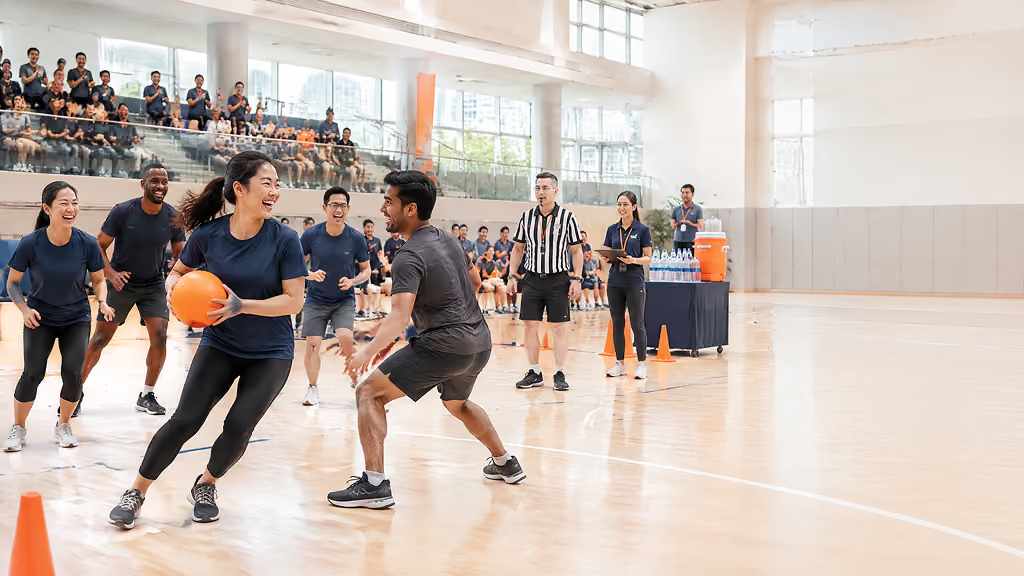
A corporate sports day is one of the few company-wide events that gives every employee, from warehouse teams to head office, a visible role on the same field. That is also what makes it demanding to plan at scale. An HR team organising for 500 or 1,000 employees is not choosing a few games; it is coordinating heats, referees, equipment, medical cover, hydration and shift schedules across a workforce that rarely stands in one place at one time.
This guide covers the decisions that shape the day: which format fits your workforce, which games work for mixed ages and fitness levels, how to weigh indoor against outdoor venues in Singapore's climate, and how to source equipment, officials and entertainment without managing five vendors. It also looks at what happens after the final whistle, because a sports day earns its budget as an engagement and recognition moment, not as an isolated afternoon of activity. Throughout, the framing is large-workforce: 500–800 employees as the entry point, scaling to 800–1,000 and beyond.
Choosing a Corporate Sports Day Format
The right corporate sports day format depends on how competitive your culture is, how much time employees can be released from operations, and how physically varied your workforce is. Four formats cover most large organisations.
1. Classic track-and-field style
A single-day programme of races, relays and field events, organised by department and run against a points table, with opening march-pasts, heats, finals and a medal ceremony. It suits organisations that want a traditional, high-energy competition, but it demands more physically, so pair every event with roles for non-runners: cheering squads, banner competitions and mascot contests can all count towards department points.
2. Carnival-sports hybrid
Half sports meet, half funfair: a core of team games surrounded by carnival stalls, inflatables, food stations and game booths, with employees free to rotate. Employees can choose how they want to participate, which makes this the natural pick when attendance spans different ages and fitness levels. It is also the format that extends most naturally into a Family Day, with spouses and children on the carnival side while employees compete in the team events.
3. Inter-department leagues run over weeks
Instead of one day, a league runs fixtures over four to eight weeks: futsal, badminton, bowling or basketball played in evening or off-peak slots, building to a finals day the wider company is invited to watch. Leagues suit organisations that cannot release the whole workforce at once, and they generate repeated engagement touchpoints rather than a single spike.
4. Inclusive low-barrier formats
A programme built entirely from games that require no athletic background: telematch-style challenges, giant board games, target games and walking relays. This is the strongest option when the priority is that every employee can take part, including older workers, and it removes the quiet opt-out problem that affects more athletic formats.
Workforce sizeFormat guidance500–800Any single-day format works in one venue; carnival-sports hybrid or classic format with staggered heats and rotating station schedules800–1,000+League format over weeks, or a split-session sports day so each shift and site gets a full programme
Games That Work for Mixed Ages and Fitness Levels
The test for every game on the run sheet is simple: could a 25-year-old warehouse assistant and a 58-year-old finance manager both play it, on the same team, without embarrassment? A large workforce is heterogeneous by definition, so the programme has to be too.
Low-barrier games most employees will join
Tug-of-war, sack races, egg-and-spoon relays, giant Jenga and target-throwing games consistently work across ages because they trade on nostalgia and coordination rather than fitness. Telematch-style team challenges, where points come from cooperation rather than speed, keep mixed-ability teams competitive to the end.
Competitive events for employees who want intensity
Sprint relays, captain's ball, futsal and dodgeball give fitter employees a genuine contest and give departments something to rally behind. Cap these at a sensible share of the programme, roughly one competitive event for every two open-participation games, so the day never feels like it belongs only to the sporty.
Staggered heats so every shift can compete
For workforces with frontline and shift-based employees, schedule the same events in repeated heats across the day so each shift competes in a full programme rather than watching a highlights reel. Results from every heat feed one combined department points table, which keeps a 24-hour operation competing as a single organisation, and desk-based teams can take the less operationally sensitive slots.
Indoor vs Outdoor: Sports Day Venues in Singapore
In Singapore, the venue decision is mostly a climate decision: an outdoor field gives space and atmosphere, while an indoor hall removes the two risks that most often derail a sports day here, namely heat and sudden rain.
FactorOutdoor field or parkIndoor air-conditioned hallWeatherExposed to rain and heat; wet-weather plan essentialFully sheltered; programme runs regardless of weatherHeat stressRequires shade, hydration points and rest cyclesAir-conditioning keeps exertion safer for longerSpaceLarge open areas for field eventsLayout must be planned, but formats adapt wellProgramme controlTimings vulnerable to weather delaysRun sheet holds; AV, emcee and music built in
The case for an indoor sports day
An indoor format keeps the entire day within your control. D'Marquee at Downtown East offers a 2,400 sqm pillarless, air-conditioned hall that functions as a blank canvas: telematch lanes, tug-of-war zones, carnival stalls and a ceremony stage can share one floor plan with no pillars breaking sightlines, and for workforces near Changi and Tampines it avoids the CBD and Marina Bay venue premium. Booking a hall from the start is also simpler than building a wet-weather contingency around an open field.
Outdoor and hybrid settings
Outdoor formats still suit organisations that want field events and space to sprawl. The wider Downtown East ecosystem gives an indoor sports day somewhere to extend to, with surrounding grounds and attractions employees can carry on to after the closing ceremony. Wild Wild Wet in the same precinct is a useful pairing: a water-based afternoon answers the heat problem that dogs most outdoor events in Singapore, and it gives employees who are not competing something genuinely worth staying for. Orchid Country Club in Yishun offers ballroom-style event spaces alongside extensive recreational facilities, a practical fit when you want competition during the day and a seated appreciation dinner in the evening at one location. Compare options on our Venues & Partner Locations page.
If you are weighing formats and venues against a specific headcount, request a package quote and our team will propose options sized to your workforce and dates.
Equipment, Referees and Entertainment via One Partner
At 500 or 1,000 participants, logistics can shape the experience as much as the programme itself, and three workstreams are worth considering carefully.
Equipment and event infrastructure
A large-format sports day needs marked lanes and zones, game equipment in team quantities, PA and scoring systems, team bibs, signage and a ceremony stage. Quantities are the reason this is harder than it looks: equipment sized for a department of thirty leaves hundreds of employees queuing when the same programme runs at company scale. UPlay for Business curates these through its partner network and coordinates them alongside its owned venues, so HR manages one point of contact rather than separate rental, AV and logistics vendors.
Referees, marshals and scoring
Neutral officials keep inter-department competition friendly. Referees, game masters and station marshals, curated via our partner network, run each event to consistent rules, keep heats to time and feed results to a central scoreboard. This matters most in staggered-heat programmes, where a points table spanning multiple sessions must be administered cleanly to be trusted.
Entertainment and atmosphere
An emcee to drive energy between events, music, photo points and carnival elements turn a competition into an occasion and give non-competing employees a reason to stay. These are likewise curated via our partner network and woven into the run sheet rather than bolted on.
Safety and Hydration Basics for Large Groups
A sports day puts hundreds of people through physical exertion in a tropical climate, so safety planning is a core workstream, not a formality.
Heat and hydration planning
For outdoor programmes, plan around heat from the start. Singapore's national Heat Stress Advisory uses wet bulb globe temperature (WBGT) readings to guide when prolonged outdoor activity should be moderated, and the Ministry of Manpower's revised heat stress framework for outdoor workers requires a 10-minute hourly rest break in shade once WBGT reaches 32 degrees Celsius for intense physical work. Those standards are a sensible benchmark for an employee event: schedule high-exertion games away from midday, provide shaded rest zones, and place water points at every station rather than one central location. Indoor, air-conditioned formats remove most of this risk.
First aid, briefings and sensible programme design
Have certified first aiders and a signposted medical point on site, with an emergency plan that marshals are briefed on. Open the day with warm-ups led from the stage, brief every station on rules and safe technique, and offer lower-intensity alternatives beside every strenuous event so nobody feels pressured into an activity beyond their fitness.
Turning Sports Day into an Engagement and Recognition Moment
A corporate sports day justifies its budget when it strengthens departmental engagement and gives the organisation a shared story, not merely a day of games.
Department pride as an engagement engine
Competing by department gives teams an identity to rally around: colours, banners, chants and a points table that operations, sales and corporate functions all care about. This is where a sports day can outperform many other company-wide events, because frontline, shift-based and desk-based employees compete for the same department on equal terms, often meeting colleagues they only know as names in a system. Beyond rooting for their own department, the day gives employees a reason to interact across departments and build the kind of friendly rivalry that carries back into the working week.
Medals and podium moments as recognition
Treat the ceremony as seriously as the games. Medals presented by senior leaders, awards that go beyond winning (best supporters, best sporting moment, most improved department) and photographs employees actually want to keep, all convert the day into visible recognition. Announcing the award categories before the day begins is worth doing: employees who know a best-supporters or most-improved-department prize is on offer put visibly more into the event trying to win it. These moments sit naturally within a broader employee engagement, recognition and wellness programme rather than standing alone.
One date in a year-round calendar
Engagement is year-round; events are the amplifiers. A sports day works best as a fixture in an annual calendar that also carries wellness initiatives, appreciation events and everyday recognition, with league fixtures, step challenges and post-event shout-outs keeping the momentum between set pieces. For large workforces, a customised employee portal can carry that continuity, administering recognition, rewards and activity sign-ups across shifts and sites so the sports day is a peak in an ongoing rhythm rather than the only touchpoint of the year.
FAQs on Corporate Sports Days
How do you organise a corporate sports day for a large workforce?
Fix the objective and headcount first, then choose a format that fits how your workforce can be released: a single-day event with staggered heats, or a league run over several weeks. Book a venue sized to your numbers early, and appoint one coordinating partner to manage equipment, officials, safety and entertainment against a single run sheet.
What games suit employees of different ages and fitness levels?
Build the core of the programme from low-barrier games such as tug-of-war, telematch challenges, sack races and target games, which reward coordination and teamwork over fitness. Add a smaller set of competitive events, such as relays or futsal, for employees who want intensity, and award points for participation and supporter roles so every employee contributes to their department's total.
Should a corporate sports day be held indoors or outdoors in Singapore?
Indoors is the lower-risk choice because it removes heat stress and wet-weather disruption, which matters when hundreds of employees are on site for a tightly scheduled programme. An air-conditioned pillarless hall such as D'Marquee at Downtown East hosts telematch zones, carnival stalls and a ceremony stage in one space; outdoor settings suit field events if shade, hydration and a wet-weather fallback are planned.
How do we include shift-based and frontline employees?
Run the same events in repeated heats across the day, or across two sessions, so every shift competes in a full programme, and feed all results into one combined points table. For 24-hour operations, a league format over several weeks is often fairer still, because fixtures can be scheduled around rosters instead of asking an entire operation to stop for one afternoon.
Can families be included in a corporate sports day?
Yes. The carnival-sports hybrid format extends naturally into a Family Day, with employees competing in team events while spouses and children enjoy carnival stalls, inflatables and open-participation games. Many organisations alternate formats year to year, or combine them into one large family-inclusive sports carnival.
Bringing Your Sports Day Plan Together
A successful corporate sports day comes down to four decisions made early: a format that matches your workforce, games that let every employee compete with dignity, a venue that takes weather off the risk register, and one partner coordinating equipment, officials, safety and entertainment. Get those right and the day repays you twice, first in the energy on the floor, then in the department pride and recognition stories that carry into the months after. From employee recognition and wellness programmes to Family Days, Dinner & Dance celebrations and workforce engagement solutions, UPlay for Business helps organisations deliver meaningful experiences at scale while reducing administrative effort for HR teams. Request a Package Quote to scope a sports day for your workforce, or see how other companies did it in our case studies.